How to Evaluate an Outlet Center Part 1: Understanding the Real Estate
Most investors begin evaluating commercial real estate by looking at the numbers. They open the offering materials, find the projected returns and start working backward through the cap rate, cash-on-cash yield or IRR. Those numbers matter, but they are not necessarily the best place to start.
Before deciding what an outlet center might earn, it helps to understand why the underlying real estate should work at all. Why should customers make the trip? What makes retailers want to be there? How protected is the property from competition? Does the physical asset actually help those retailers succeed?
These questions may sound qualitative, but the answers do not have to be subjective. Customer behavior can be measured. Competition can be mapped. Tenant concentration can be calculated. Trade areas and new supply can be compared.
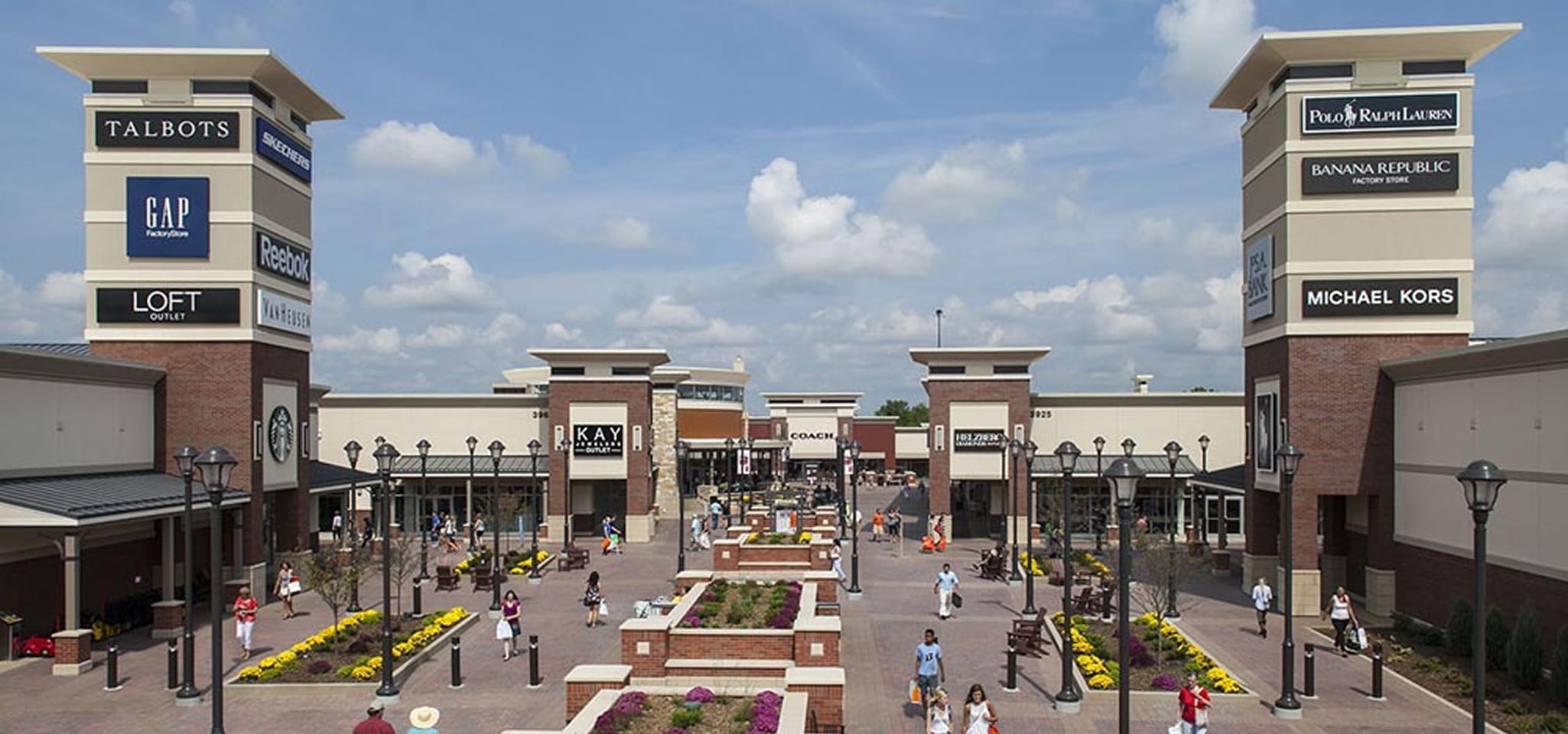
Throughout this article, we'll use OKC Outlets, a 394,000-square-foot outlet center in Oklahoma City, as a real-world case study to illustrate how that evaluation works in practice. So before opening the rent roll, start with the real estate.
Start With the Format: What Are You Actually Buying?
The first question in starting an evaluation is simple: What exactly are customers coming to an outlet center to do?
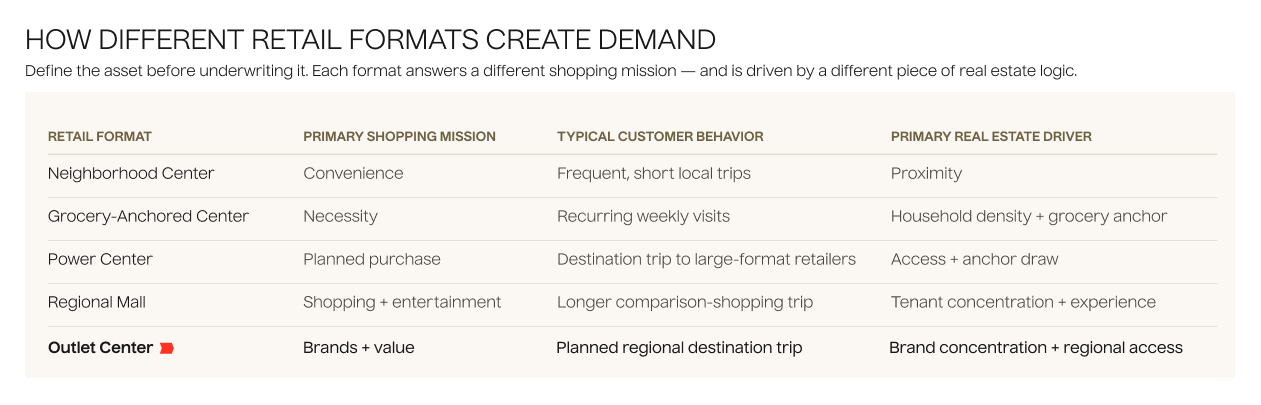
Retail is not one asset class. A neighborhood center, grocery-anchored center, power center, regional mall and outlet center each serve a different shopping mission. That difference influences where the property needs to be located, how far customers will travel, and what ultimately gives the real estate value.
An outlet center asks something specific of its customer: make a planned trip to a concentration of recognizable brands offering value-oriented shopping. That is different from convenience retail, where proximity matters most, or a grocery center built around frequent local visits.
OUTLET CENTER
A destination-oriented retail center that brings together outlet stores from multiple brands, typically offering merchandise at discounted prices and drawing shoppers from a broader regional trade area.
Outlet shopping also differs from off-price concepts such as TJ Maxx, Marshalls or Burlington. These are often categorized as “Treasure Hunts” and rely on discovery and an ever-changing assortment. Outlet shopping tends to be much more brand-driven. A customer may arrive specifically looking for Nike, Coach, Polo Ralph Lauren, or Adidas and knows those stores will be there.
That distinction changes what “good real estate” looks like. A five-mile population ring that may be critical to a grocery center tells only part of the story for an outlet center. Regional access matters more. And a Nike store is not simply a tenant occupying space. It may be one of the reasons someone drives an hour to the property in the first place.
This gives us the starting point for evaluating the format. If the shopping mission requires customers to make a trip, the property has to give them a reason to make it.
Location: Is the Demand Real, and Is It Protected?
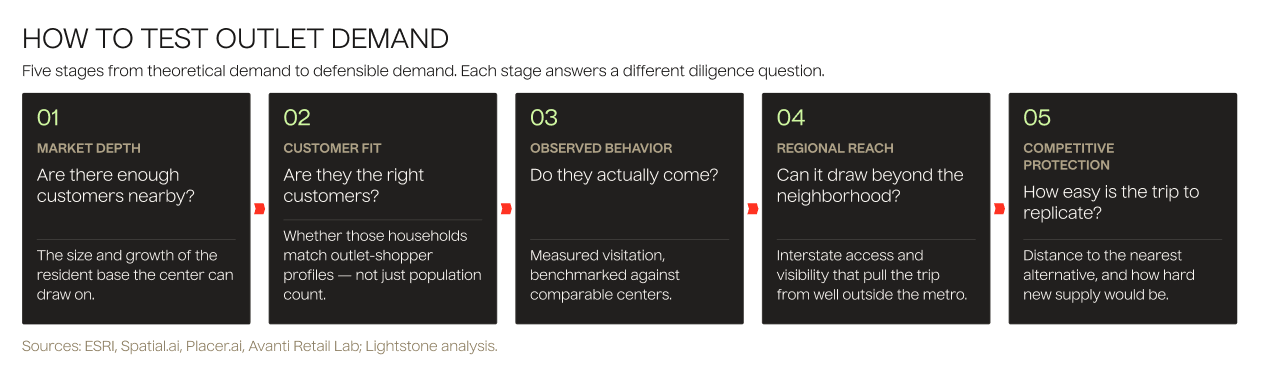
Next, “location, location, location.” But what actually makes a good outlet location? A large population nearby certainly helps, but that alone does not tell us whether people will drive 30, 50 or even 100 miles to shop there. A strong outlet center needs enough nearby customers to support repeat business, while also reaching a wider regional audience willing to make a planned trip.
Start With the Local Base
Start close to home. Oklahoma City's metropolitan population is approximately 1.5 million, with ESRI projecting another 3.9% of growth through 2030. But population alone isn't the thesis. The more important question is whether those households resemble the customers most likely to shop at an outlet center.
Are They the Right Customers?
At OKC Outlets, third-party analysis identified approximately 163,000 outlet-target households within the property's trade area, nearly 29,000 more than the average across nine comparable outlet centers analyzed. About 50.7% of households fall within those target customer segments, compared with 45.9% across the comparable set.
The income data adds useful context. Household income around OKC Outlets is somewhat lower than the comparable-center average, yet the trade area contains more target households overall and more households earning between $100,000 and $200,000 annually. The strength here is less about affluence than about the scale and composition of the addressable customer base.
Are They Showing Up?
But demographics only tell us who could come. The next test is whether those customers actually show up.
OKC Outlets recorded approximately 2.61 million visits from 1.16 million unique visitors over the measured twelve-month period, approximately 193,000 more visits and 232,000 more unique visitors than the comparable-center average. The property is therefore demonstrating an ability to draw a relatively large number of distinct shoppers.
Demographics establish potential demand. Visitation tests whether it's real.
Accessibility helps extend that demand beyond the immediate neighborhood. OKC Outlets sits directly along Interstate 40, giving shoppers across central Oklahoma a straightforward route to the property. For destination retail, the relevant customer may not live five miles away. It may be a family 45 minutes away deciding whether the assortment of brands makes the drive worthwhile.
How Protected Is the Demand?
Then look at how protected that customer base is. OKC Outlets is the only outlet center in the Oklahoma City market. The other Oklahoma outlet center is approximately 100 miles away in Tulsa, while outlet options in Dallas–Fort Worth are roughly 160 miles away. For a planned shopping trip, that separation creates meaningful breathing room.
Limited competition today is useful, but it's worth asking what would stop someone from building another outlet center tomorrow.
New outlet supply requires more than available land. A developer needs regional access, sufficient scale, capital, and enough national retailers willing to commit before the project can become a credible destination. More broadly, retail development remains constrained nationally, making successful existing centers harder to reproduce than during heavier development cycles.
Scarcity alone is not an advantage. A market can have little competition because demand is weak. Scarcity becomes valuable when it protects demand that customers and retailers have already demonstrated.
A strong outlet location needs both sides of the equation: enough of the right customers to support the destination and enough protection to make those customers difficult for a competing outlet center to take away.
These are among the factors Lightstone’s acquisitions and asset management teams consider when evaluating retail opportunities, informed by decades of experience investing in and operating across the asset class.
Tenants: Is the Roster Worth the Trip?
If the location can attract customers, is there actually something worth traveling for once they get there?
The Brands Are the Product
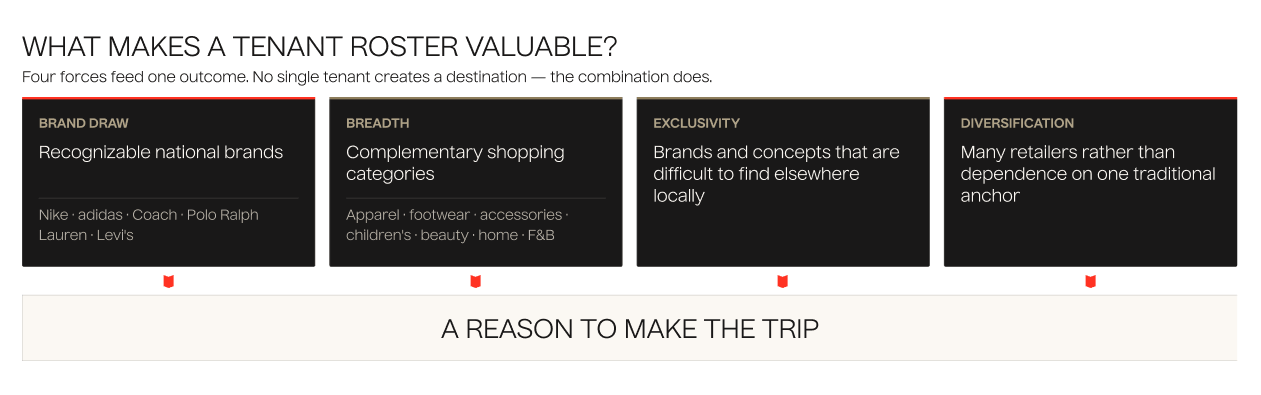
In an outlet center, the brands are the product. Recognizable national retailers such as Nike, Adidas, Coach, Polo Ralph Lauren and Levi's already have consumer demand attached to their names. A shopper may plan an outlet trip around only two or three stores, making those brands part of the attraction that creates the visit in the first place.
For ownership, established national retailers offer another advantage. They generally bring greater financial resources, operating infrastructure, and more established credit profiles than a roster dominated by smaller operators. They are also making their own investment decisions. Opening and operating a store requires capital, inventory, employees, and management attention. Before committing to a location, the retailer has evaluated the market, location, and expected store performance. Their commitment does not replace an investor's diligence, but when sophisticated retailers independently commit capital to the same property, their behavior becomes another useful data point.
Still, a collection of famous logos does not necessarily make a strong outlet center. What happens after the customer visits the two stores that brought them there matters just as much.
A Mix That Extends the Trip
This is where merchandising matters. Outlet centers naturally lean toward apparel, but a strong mix gives shoppers reasons to turn one planned purchase into a broader trip. Someone arriving for athletic apparel may also buy shoes, shop for children, browse accessories or stop for food. The right combination creates more reasons to continue shopping while allowing individual retailers to benefit from traffic generated by the rest of the property.
OKC Outlets provides a useful example. Its 94-tenant roster spans apparel, footwear, accessories, home, children's, beauty, food and beverage, jewelry and entertainment. Apparel is the largest category at roughly half the center, while the balance is distributed across those complementary uses. For the customer, that breadth creates more ways to shop in a single trip. For ownership, it also spreads exposure across many retailers and merchandise categories rather than relying on a single traditional anchor.
Exclusivity can make that mix even more valuable. OKC Outlets has 20 tenants exclusive to the Oklahoma City MSA, including 11 outlet tenants found nowhere else in Oklahoma. That matters because destination retail needs to offer something customers cannot easily recreate closer to home. The more differentiated the assortment, the stronger the reason to make the trip.
A strong tenant roster does much more than fill space. The right brands create the trip, the right mix extends it, diversification spreads the owner's exposure, and exclusivity makes the shopping experience harder to replicate elsewhere.
The Physical Asset: Is It Designed to Sell?
Once the market and retailers make sense, walk the property. What is the real estate itself actually doing to help them succeed?
Start with a customer who arrives specifically for Nike. After that purchase, can they walk straight back to the car, or does the property naturally expose them to adidas, Coach, Levi's and other storefronts along the way? That difference is why physical design matters.
Does the Property Move Customers?
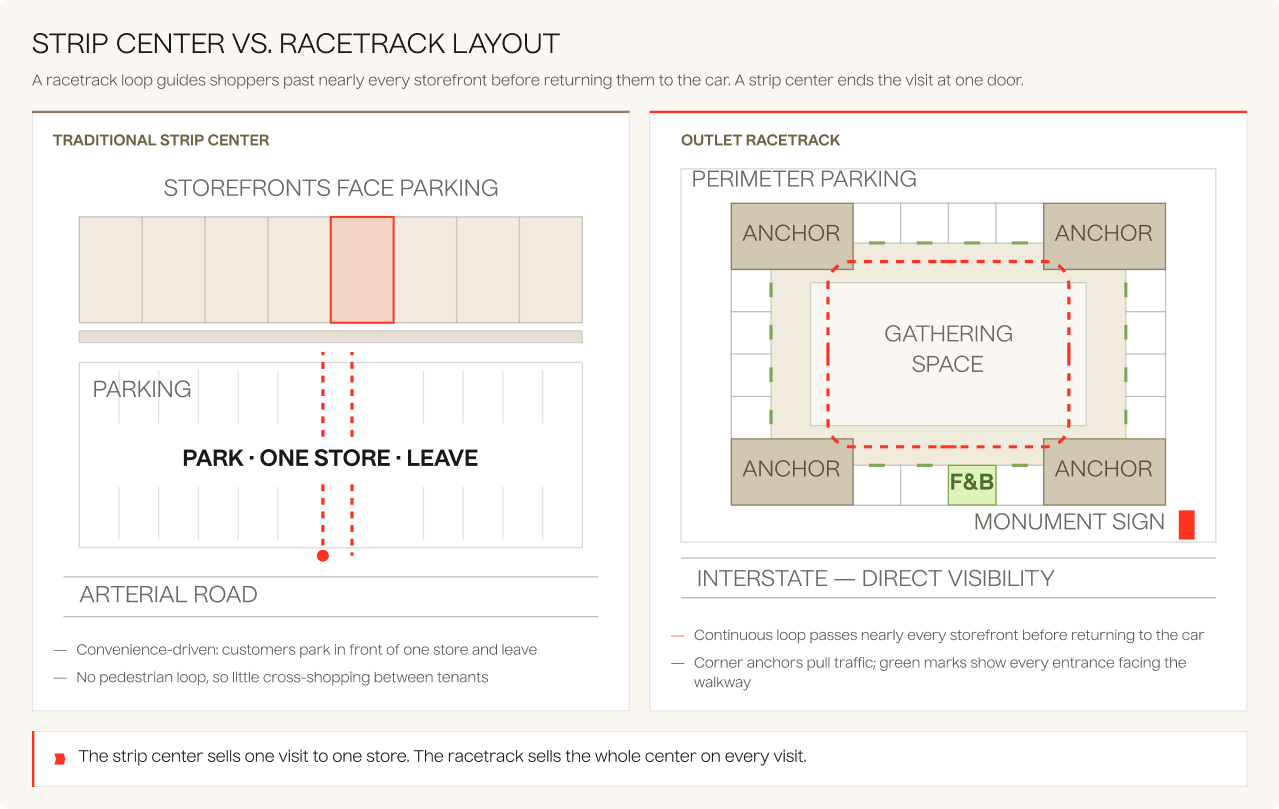
Many outlet centers use a racetrack-style layout that guides shoppers through a continuous pedestrian loop. Compare that with a strip center, where someone can park in front of one store, make a purchase and leave without seeing another storefront.
The racetrack changes that behavior. Nike may have created the original visit, but the layout gives every other retailer a chance to benefit from it.
Simply having a loop is not enough. Does every part of the center benefit from that circulation, or are there dead zones customers rarely reach? The placement of major traffic generators matters, and so do shortcuts, gathering areas, food and beverage options, and the ability to relocate tenants to strengthen weaker stretches. The site plan is doing more than organizing buildings; it determines how effectively the property shares customers among its tenants.
Make the Trip Easy to Extend
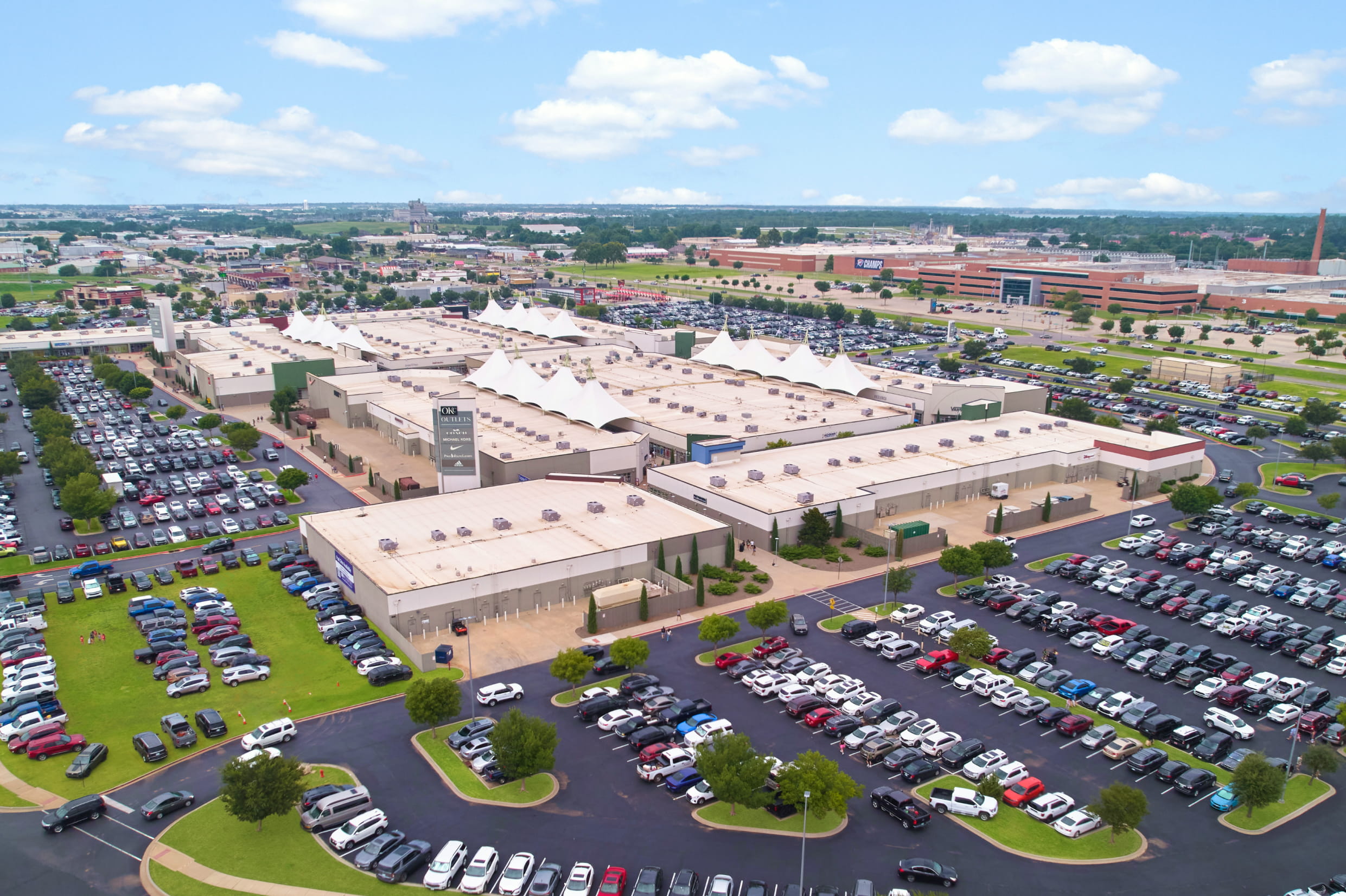
Before that circulation can create value, customers have to get onto the property, and outlet shoppers have already accepted more friction than someone stopping at neighborhood retail. The physical asset should remove as much of that friction as possible. At OKC Outlets, Interstate 40 frontage and prominent signage help customers identify the center, while surface parking and a single-story, open-air format make the transition from car to storefront simple. The real question is not whether the property has enough parking or good signage, but whether the entire arrival experience makes a planned regional trip easier rather than harder.
Then comes another question: what makes a customer stay for another hour instead of leaving after the first purchase? This is where ordinary physical features matter. Canopies and shade make a long trip more comfortable in Oklahoma heat or rain, seating lets families pause, and food and beverage gives shoppers a reason to take a break without ending the trip. Parking, signage, landscaping, restaurants and common areas should all be viewed through the same lens: each should help customers arrive, move through the property or stay longer.
Stay Useful as Retail Changes
Today's tenant roster will not be tomorrow's, and the physical property has to change with it. A 12,000-square-foot space may eventually need to become two smaller stores, or a growing retailer may want adjacent space; store depth, frontage, utilities, loading and demising walls all affect how easily ownership can respond without a costly reconfiguration.
Condition matters, too. Roofs, HVAC systems, paving, lighting, facades, and signage eventually require capital. An older center is not automatically a weaker investment; what matters is whether its condition and expected capital needs are consistent with the business plan and whether the buildings remain useful to the retailers ownership wants to attract.
That is the ultimate physical test: is the property designed to sell today, and can it remain useful as retail changes tomorrow? The best outlet real estate does more than house tenants. It helps customers find the property, exposes them to more stores, makes it easier to stay, and gives ownership enough flexibility to keep the center relevant over time.
The Operator: Who Protects the Advantage?
By this point, we may have identified the right customers, limited competition, compelling brands, and functional real estate. The final question becomes whether the team behind the property knows how to protect them and build on them over time.
For an outlet center, that starts with leasing. The brands are a major part of what brings customers to the property, making the team responsible for maintaining that roster especially important. National retailers operate across markets and outlet portfolios, so established relationships can matter when leases expire, spaces become available or ownership wants to introduce a new brand. The question is not simply whether a leasing team can fill a vacancy. Can it maintain the right mix of retailers, strengthen the property, and keep the destination relevant as consumer preferences change?
The same applies to ownership. Retail is an operating business. Tenant spaces change, merchandising evolves and physical improvements compete for capital. An experienced operator needs to understand how those decisions work together rather than treating leasing, property operations and capital investment separately.
Relevant experience matters, particularly in a specialized format like outlet retail. Lightstone, for example, previously owned and operated the Prime Outlets portfolio, which was sold to Simon Property Group in 2010 for approximately $2.33 billion. Past experience does not guarantee future results, but experience across outlet centers and retail cycles can provide useful perspective when evaluating markets, working with national retailers and making decisions over a property's hold period.
In the end, the operator is responsible for connecting everything we have evaluated: Can the team preserve the brands that create the trip, maintain the real estate that supports it and adapt both as the market changes?
A strong outlet center may begin with good real estate. Keeping it strong is an operating job.
The Bottom Line
The asset type defines the shopping mission. The location determines whether enough of the right customers can make the trip and how protected that demand is. The retailers give them a reason to come. The physical property determines how effectively that traffic moves through the center. And the operator has to keep those advantages relevant as markets and retailers change.
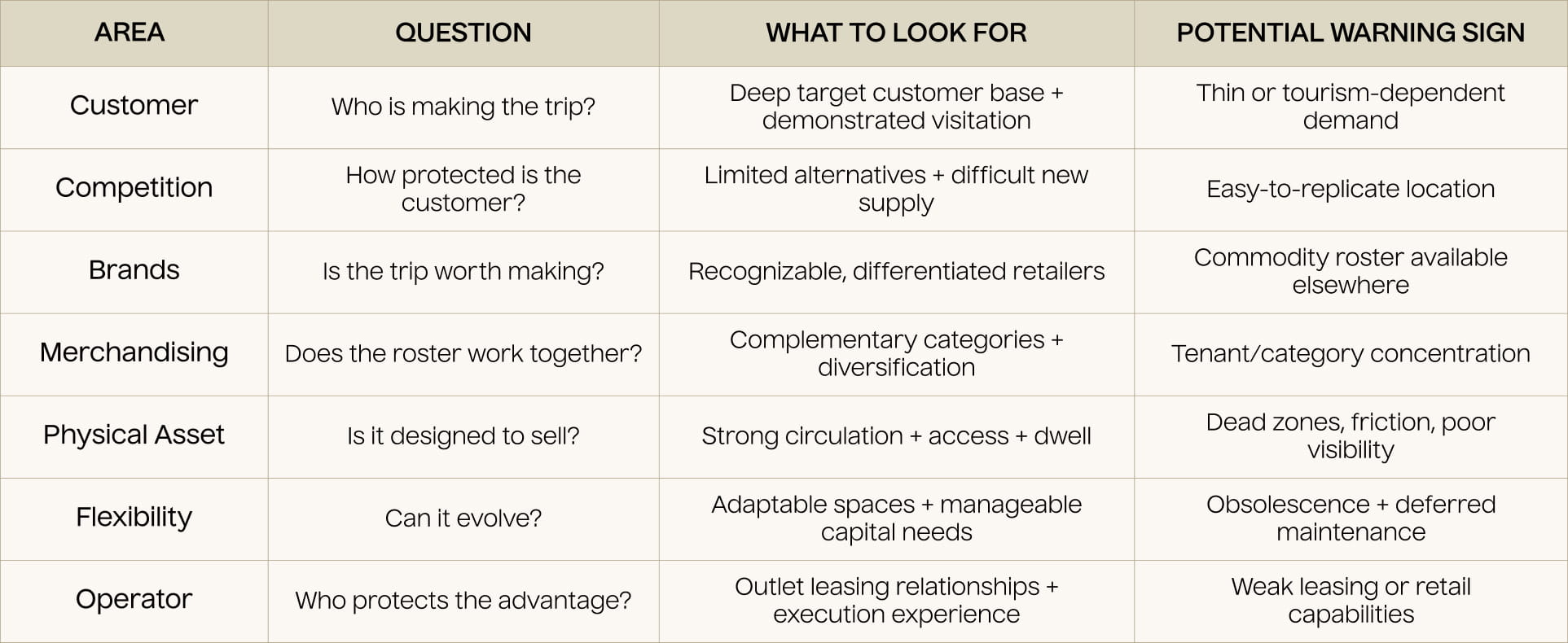
No single characteristic needs to be perfect. The goal is to understand what job each part of the real estate needs to perform, whether it is actually performing that job and what evidence supports the conclusion.
Part 2 takes the next step. Sales productivity, occupancy costs, lease structures and rollover help determine whether the economics confirm what the real estate appears to be telling us.
Understanding the real estate tells you what you're buying. Understanding the operating metrics tells you whether you're buying it well.
Sources:
- Oklahoma City Outlets, Retail Equity Investment Offering, Lightstone DIRECT, July 2026.
- Avanti Retail Lab, OKC Outlets Market & Asset Analysis, May 2026; underlying demographic and visitation data from ESRI and Placer.ai.
- International Council of Shopping Centers (ICSC), U.S. shopping-center classification and outlet-center resources.
- Newmark, U.S. Retail Market Conditions & Trends, Q1 2026.
- Simon Property Group, Prime Outlets acquisition and transaction materials, 2009–2010.
Important context This article is for general informational and educational purposes only. Neither this article nor the information contained in it constitutes an offer to sell or a solicitation of an offer to buy any security, including any interest in OKC Outlets or any other Lightstone offering. Any such offer is made only by means of a confidential private placement memorandum to persons who qualify as accredited investors and who have been verified as such in accordance with Rule 506(c) of Regulation D. Forward-looking statements and hypothetical examples reflect current expectations and assumptions only; actual results may differ materially. Third-party information is believed to be reliable but has not been independently verified. Past performance is not indicative of future results

Storm Murphy
Storm Murphy is Associate Director of Capital Formation at Lightstone DIRECT, where he helps lead the firm’s capital raising efforts across its multifamily and industrial investment platforms. He combines investment strategy, financial acumen, communication, and strategic marketing to enhance the investment experience for high-net-worth individuals, RIAs, and family offices.
Before joining Lightstone, Storm raised capital across the Midwest in the multifamily space. He holds a Bachelor's in Finance from Wofford College, where he captained the Division I basketball team to an NCAA Tournament appearance and later helped lead Virginia Tech to an ACC Championship. He brings the same leadership, discipline, and competitiveness developed on the court to his work in capital markets. Outside of the office, he’s an avid golfer and enjoys playing Texas Hold’em.


How to Evaluate an Outlet Center Part 2: The Metrics to Pay Attention To


.jpg)
[Webinar] Retail's Quiet Comeback

[Video] Introducing OKC Outlets
[Webinar] New Opportunity: OKC Outlets
%20(1).jpg)
Retail Real Estate Investing: Why Outlet Centers Deserve Another Look
How is an outlet center different from an off-price store like TJ Maxx?

Off-price retailers rely on discovery and a constantly changing assortment, often described as a treasure hunt shopping experience. Outlet shopping is more brand-driven. A customer typically knows which specific brands will be there and plans the trip around them.
What makes a strong outlet center location?
A strong outlet location needs two things at once: enough of the right customers nearby to support repeat visits, and enough protection from new competing supply that those customers are hard for a competitor to take away. Scarcity alone isn’t valuable if it just reflects weak demand. It becomes valuable when it’s protecting demand that’s already been proven out.