A Misunderstood Corner of Commercial Real Estate (and Why We're Buying Into It)
%20(1).jpg)
Retail real estate is easy to misunderstand because the word retail covers a variety of different properties. A regional mall, a grocery-anchored center, a neighborhood strip center and a single-tenant big-box store may share the same broad label, but their tenants, lease structures, credit risk, capital needs and demand drivers are not the same.
From an investment perspective, this distinction is important. The conventional view is that e-commerce permanently weakened physical retail. It certainly changed the sector, and some properties and retailers didn’t adapt. But the data increasingly shows a market that has sorted into winners and losers rather than one in broad decline.
One format that gets almost no attention these days is the outlet center. We know it better than most. In the early 2000s, Lightstone was one of the larger outlet owners in the country through Prime Outlets, a portfolio we sold to Simon Property Group in 2010 for $2.33 billion. Our retail holdings peaked at roughly 12 million square feet, and through the 2010s we deliberately sold down much of that exposure as we saw fundamentals changing. We have been a buyer, an operator, and a seller through a full cycle.
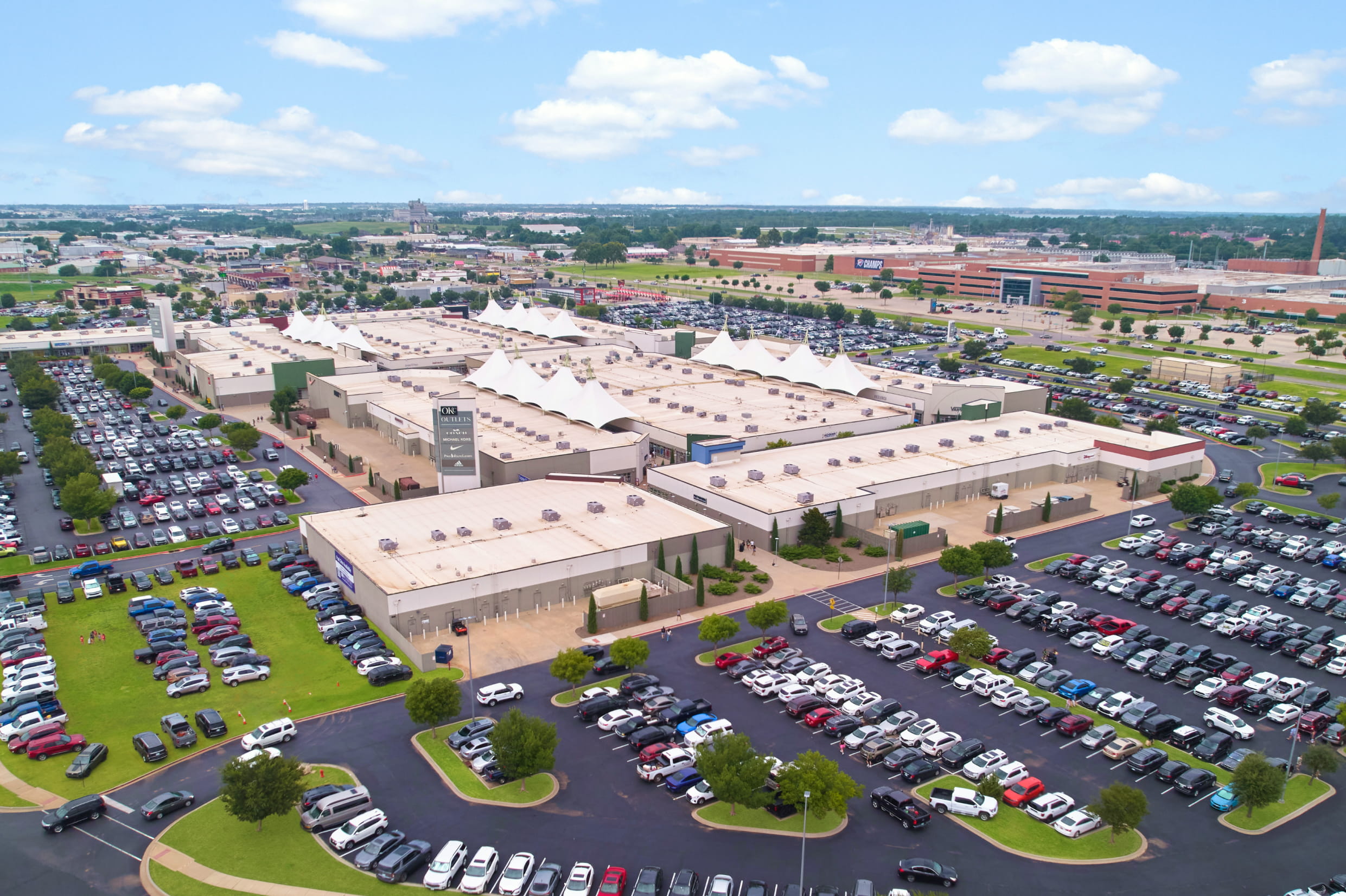
Now we are buying again. Lightstone is acquiring OKC Outlets, a 394,280-square-foot open-air outlet center just outside downtown Oklahoma City, for $80 million.
So Why Retail, and Why Now?
Start with supply and demand. According to CoStar, national retail vacancy sits at roughly 4.4%, with the amount of available space near historically low levels, and retail construction starts have fallen to multi-decade lows amid sharply rising costs. Very little new retail pencils at today’s construction costs and market rents, so nearly all tenant demand flows into the existing stock. When demand is steady and supply keeps shrinking through demolition and conversion, well-located centers gain pricing power.
But what about Amazon? It’s a fair question, and a decade ago it was largely the right one for a specific slice of the market. The data today tell a different story. Per the Census Bureau, e-commerce accounted for 16.9% of total retail sales in the first quarter of 2026, which means physical channels still capture more than 80% of retail spending. More importantly, the two channels increasingly support one another: ICSC’s Halo Effect research found that opening a physical store lifts a retailer’s online sales in the surrounding trade area by roughly 7%.
Closures will always be a risk in retail, but they are receding. Coresight Research projects approximately 7,900 U.S. store closures in 2026, a three-year low, alongside roughly 5,500 openings, which are on the rise. And well-located centers have shown they can replace bankrupt tenants at higher rents: Kimco, a publicly traded shopping center REIT, backfilled four former Bed Bath & Beyond boxes at a blended rent increase of 57%.
The consumer is holding up as well. According to the Census Bureau, retail and food services sales rose for a fifth consecutive month in June and were up 6.7% from a year earlier, with sales excluding autos and gas up 5.7% over the same period.
Why Outlets Specifically?
The outlet business has evolved considerably over the past two decades. While outlets were once known primarily for selling excess inventory and discontinued merchandise, many brands now develop product specifically for the outlet channel alongside traditional clearance goods. That evolution has transformed outlets from a liquidation channel into a permanent part of many retailers' distribution strategies, allowing brands to serve value-oriented consumers while maintaining a distinct full-price business.
A common misconception is that off-price retailers like TJ Maxx, Marshalls, or Nordstrom Rack are replacing the outlet model. In our view, there is room for both. An outlet shopper visits brand-controlled stores looking for a deal on a specific label, while off-price is treasure-hunt shopping where you never know which brands will be on the floor that day.
The economics explain the durability. In a healthy outlet center, tenants generally maintain occupancy cost ratios of roughly 10% to 12%, meaning $10 to $12 of every $100 in sales goes toward rent and related charges. Stores that are profitable tend to renew, which is why outlet occupancies have proven so sticky and why the format carries relatively low ongoing capital needs.
Because there are few public companies dedicated to the outlet sector, Tanger (Ticker SKT) provides one of the clearest windows into the operating fundamentals of U.S. outlet centers. As the only publicly traded REIT primarily focused on outlets, its reported tenant sales, leasing activity, occupancy and rent growth are among the best publicly available indicators of conditions across the outlet market.
Tanger's tenant sales productivity has climbed to an all-time high of $482 per square foot as of Q1 2026, capping a steady rebound from the $436–$438 range where sales sat through much of 2023 and 2024. Full-year 2025 tenant sales reached $473 per square foot, up roughly 7% year over year, while the company leased more than 3.0 million square feet — the highest annual total in its history. Same-center net operating income grew 4.3% for the year, occupancy finished near 98%, and Tanger subsequently raised its 2026 guidance.
.jpg)
Those results were not driven by occupancy alone. During the 12 months ended March 2026, Tanger executed 3.4 million square feet of leases at a blended cash rent increase of 10.5%, including substantially higher rents on space leased to new tenants — pricing power that shows up directly in the productivity trend: sales per square foot have now risen for five straight quarters since bottoming in late 2024.
We have seen this in our own portfolio. In 2024, Lightstone acquired the Outlet Collection in Seattle for $82 million. Occupancy at that property now stands at approximately 98%, and the center drew nearly 11 million visits in 2025.
Why OKC Outlets?
The property itself is the prototypical modern outlet: an open-air “racetrack” layout built in 2013, with highway visibility and the store sizes retailers actually want. It is home to more than 70 national tenants and is anchored by names including Nike, Coach, Old Navy, The North Face, Gap, and Adidas.
Its defining feature, though, is the trade area. OKC Outlets is the only outlet center serving the Oklahoma City metro and its more than 1.5 million residents, with the nearest competing outlet roughly 110 miles away in Tulsa and the next closest nearly 190 miles away in the Dallas–Fort Worth area. The center attracts approximately 2.6 million visits a year, and with no new outlet supply on the horizon, we believe direct competition is unlikely any time soon.
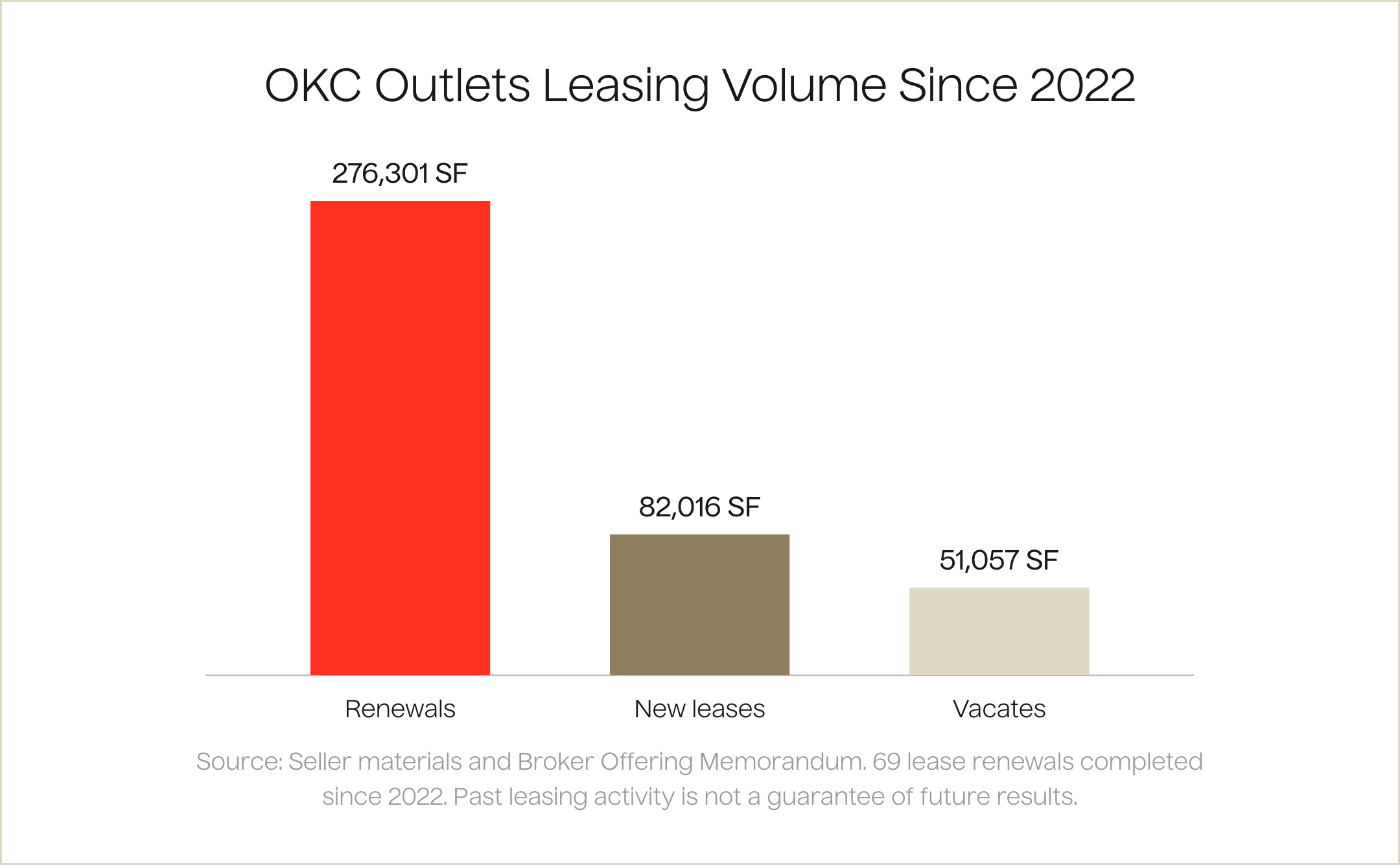
The more important question is whether retailers recognize that advantage. Recent leasing suggests they do. Since 2022, 69 lease renewals totaling more than 276,000 square feet have been completed, alongside 82,016 square feet of new leases against 51,057 square feet of vacates. The property is 97.5% occupied today, has averaged 92% occupancy since 2018, and never fell below 87%, even during COVID. As of July 2026, 11 retailers operate their only Oklahoma location at the property, and 20 more have their only Oklahoma City metro location there.
Importantly, more than 80% of leases expire within the next four years, and permanent tenants maintain occupancy costs of roughly 10% of sales. That combination positions us to pursue rent growth selectively while retaining productive tenants and improving the merchandising mix over time.
Why This Price (and Why a 10-Year Hold)?
At Lightstone, we believe the price paid for an asset is one of the most important forms of risk mitigation. We cannot predict where interest rates, cap rates, or property values will be years from now. But we can remain disciplined about the basis at which we invest.
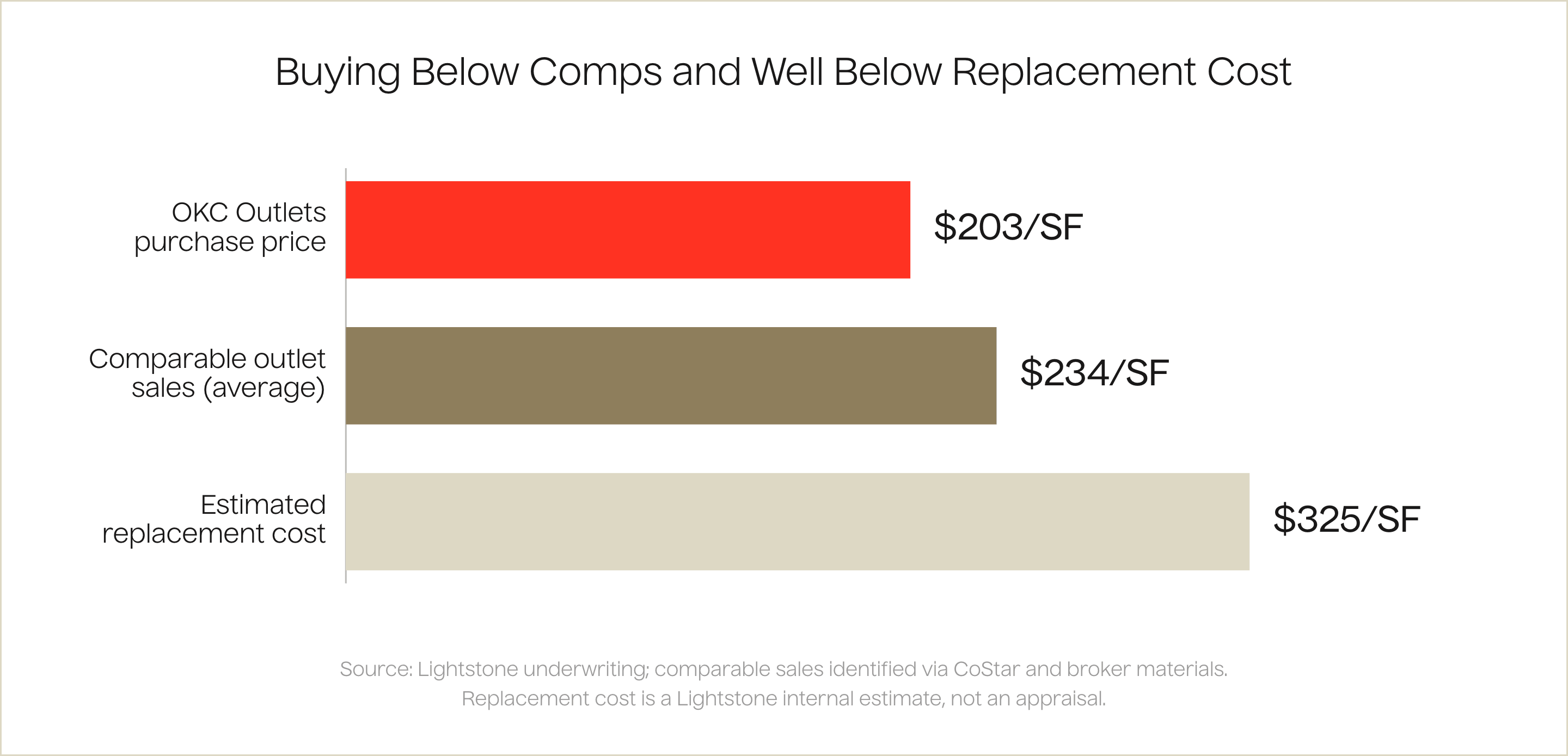
We are acquiring OKC Outlets for $80 million, approximately 38% below the $130 million paid for the property in 2017. Our basis of roughly $203 per square foot is also approximately 13% below the comparable outlet sales we reviewed and 37% below our estimated replacement cost of $325 per square foot.
So the question you might be asking yourself is: if the property is performing, why the discount? In our view, the occupancy history and leasing activity above do not point to deteriorating retailer demand. We attribute the decline in value to the cap-rate expansion that occurred across the outlet sector as interest rates rose, a repricing similar to what strip centers experienced before their cap rates recovered.
Based on our underwriting, we are acquiring the property at a projected 10.1% going-in cap rate (the property’s projected first-year net operating income as a percentage of the total investment). That starting yield matters because we expect most of the investment’s projected return to come from cash flow. Our underwriting does not assume cap-rate compression and does not depend on significant appreciation to reach our proforma net IRR of 11.8% and proforma net average annual cash-on-cash return of 11.6%.
That return profile also explains the holding period. Our first two Lightstone DIRECT offerings carried four-year holds, while OKC Outlets is underwritten to a 10-year hold. The reason is simple: when a property is projected to generate an approximately 11% net annual cash-on-cash return, we believe the best way to capture it is to own it for a long time, because very little of the projected return depends on the back-end sale.

Putting It All Together
So putting this all together: retail fundamentals are the strongest they have been in years, outlets have quietly become one of the more resilient corners of the space, and OKC Outlets gives us a market-dominant asset at a projected double-digit starting yield and a meaningful discount to both comparable sales and replacement cost.
We are clear-eyed about the risks. Consumer spending is cyclical, an apparel-heavy tenant roster requires active management, and the buyer pool for outlet centers is thinner than for multifamily or industrial. Those are real considerations, and they are part of why the asset is priced where it is.
But we sold this format near the top in 2010, and fifteen years later we believe we are buying it well below where the market once valued it. More than 15 years after e-commerce was supposed to finish off physical retail, the stores are still standing, the leases keep renewing, and well-located centers keep producing cash flow. We think that is worth paying attention to.
SOURCES
CoStar Group retail forecasts (2025–2026); U.S. Census Bureau, Quarterly Retail E-Commerce Sales (Q1 2026) and Advance Monthly Retail Sales (June 2026); ICSC, The Halo Effect III: Where the Halo Shines (2023); Coresight Research, U.S. store openings and closures outlook (2026); Kimco Realty Q4 2023 results; Tanger Inc. Q4 2025 and Q1 2026 results; Lightstone underwriting, seller materials, and Broker Offering Memorandum for OKC Outlets.
This article is for informational purposes only and does not constitute an offer to sell or a solicitation of an offer to buy securities. Any offering is made only to verified accredited investors pursuant to definitive offering documents. Projected returns, including proforma net IRR and cash-on-cash figures, are forward-looking estimates based on assumptions that may not be realized; actual results may differ materially, and investors could lose their entire investment. Past performance, including Lightstone’s prior retail investments, is not indicative of future results. Third-party data are believed reliable but have not been independently verified.

Jonathan Spitz
Jonathan Spitz is the Head of Capital Formation at Lightstone DIRECT, where he oversees fundraising and business development activities associated with Lightstone’s real estate investment platform. With more than a decade of experience in private real estate, Jonathan specializes in helping high-net-worth individuals, RIAs, and family offices access institutional-quality multifamily and industrial opportunities. Before joining Lightstone, Jonathan spent five years at Origin Investments, where he played a key role in scaling the firm’s capital raising efforts among RIAs, family offices, and high net worth individuals.


How to Evaluate an Outlet Center Part 2: The Metrics to Pay Attention To

How to Evaluate an Outlet Center Part 1: Understanding the Real Estate

.jpg)
[Webinar] Retail's Quiet Comeback
[Video] Introducing OKC Outlets
[Webinar] New Opportunity: OKC Outlets