Why Grand Rapids Now?
The Case for Multifamily in a Durable Midwest Market
Grand Rapids is not the kind of market that usually dominates national real estate headlines, and this is part of the appeal for us at Lightstone. For much of the last cycle, the dominant multifamily trade was straightforward: buy Sunbelt growth, follow migration, and rely on rent growth to do the rest. That framework has been and continues to be challenged as new apartment deliveries have been consistently outpacing demand, pressuring rents and increasing concessions.
However, Grand Rapid offers a different set up where strong risk adjusted returns can be generated without relying on aggressive growth. It is a proven Midwest market with stable fundamentals, and a diversified economy that is growing faster than most of its Midwest peers. In 2026, those dynamics are aligning in a way that makes Grand Rapids particularly compelling for multifamily investors.
A City on the Rise
Grand Rapids is not a one-industry town. Its economy spans healthcare, advanced manufacturing, technology, professional services, and logistics, anchored by Corewell Health, the second-largest employer in the state. The Medical Mile, a concentrated corridor of health sciences institutions and research facilities, has become one of the most significant biomedical clusters in the Midwest, supporting close to 60,000 health sciences jobs and drawing continuous investment in research, clinical infrastructure, and talent. Manufacturing, long the backbone of West Michigan's economy, has proven more resilient here than in most comparable metros, and a growing technology sector is diversifying the job base further.

The economic results are reflected in the regional numbers. Grand Rapids leads the Midwest in population growth with an 8% increase over the past decade, and it recorded the highest household income growth among major Midwest metros, reaching a median of $80,296. Private businesses grew by 33.3% from 2013 to 2023, the fastest rate among major Midwest peers. The greater Grand Rapids region now encompasses roughly 1.1 million people across 8 counties and added just over 5,000 jobs in 2024, with growth concentrated in manufacturing and technology.
What distinguishes Grand Rapids from other Midwest markets is not just that it is growing, but who is driving that growth. The region graduates roughly 10,300 students annually across more than 20 universities and retains approximately 80% of them each year, a figure that regional economic development leaders describe as the primary engine of population growth. Since 2019, Grand Rapids has led every large metro in the country in the percentage growth of its creative class, expanding by 6.1 percentage points. The 25 to 34 cohort with a bachelor's degree or higher has grown nearly 20% since 2019, more than double the statewide rate. At a median age of 36.6, Grand Rapids is among the youngest metros in the Midwest. Young, educated, and employed residents are the core renter demographic, and Grand Rapids is producing more of them and keeping more of them than almost any comparable market in the country.
Major planned investments in the area include a billion-dollar riverfront development, including a new soccer stadium, amphitheater, and hundreds of new housing units, in addition to a $795 million Fulton & Market development backed by the Michigan Strategic Fund. Infrastructure investment and neighborhood revitalization of this scale tends to support population retention and housing demand across the city.
Affordability is a Powerful Tailwind
One of the strongest drivers of apartment demand today is the widening gap between the cost of renting and the cost of homeownership. The average home in the Kentwood submarket is priced around $327,500. At a 6.5% interest rate, including taxes and insurance, the estimated monthly ownership cost is $2,175. The average apartment rent in the area is roughly $1,500/month. That is a $675 monthly premium to own, or approximately 45% more expensive than renting.
For many households, buying a home now requires a materially higher monthly payment than renting an apartment in the same area once mortgage costs, taxes, and insurance are factored in. In submarkets such as Kentwood, that premium has become large enough to keep many would-be buyers in the rental market longer than expected.
This affordability dynamic creates a powerful tailwind for multifamily owners. It extends renter duration, supports occupancy, and reinforces demand across the workforce housing segment. In other words, rental housing is no longer simply a stepping stone to ownership for many households. It is the more rational financial choice.
Supply Is Limited, and That Is the Opportunity
In today’s multifamily environment, supply discipline is one of the most important determinants of performance. Markets that received a lot of new supply over the last several years are now absorbing the consequences through slower rent growth and rising concessions. Grand Rapids largely avoided that cycle.
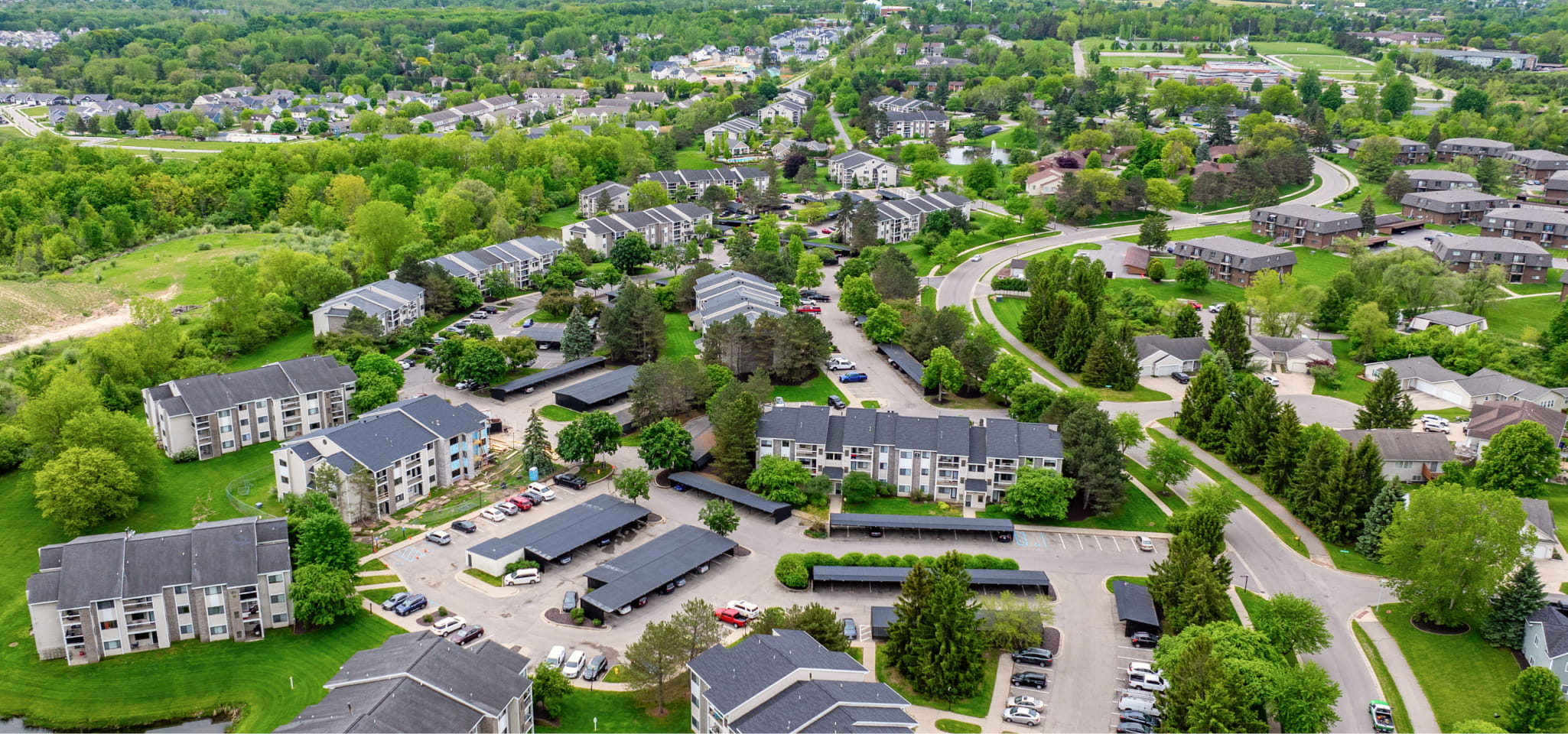
Our Hidden Lakes multifamily project is located in Kentwood, with convenient access to the airport, 28th Street commercial corridor and the South Division corridor, supporting connectivity to retail, services, transit, and major employment nodes across the broader Grand Rapids area. Additionally,, Kentwood is one of the most stable submarkets in the region in terms of supply. While the submarket did receive a wave of deliveries in 2024, it was relatively measured compared to other neighborhoods. And today, new construction starts have remained muted, which means there is virtually no new supply on the horizon for the next several years.

Despite a significant uptick in deliveries in 2024, annual rental demand in Kentwood has been positive in every period over the last 3 years, and average annual rent growth has been roughly 3.0%.
Looking ahead, third-party forecasters such as AxioMetrics is projecting the Grand Rapids MSA will average annual rent growth of 3.66% over the next four years. Lightstone's internal underwriting for the Hidden Lakes investment is notably more conservative, modeling 2.75% average annual growth over the hold period.

Why We're Investing in Grand Rapids
Over the past five years, a multi-decade high in new multifamily supply and intense competition for assets have reshaped how investors should think about market selection. At Lightstone, our experience has shown us that the most popular markets or investment themes do not always produce the best returns. The Sunbelt markets that captured so much investor attention in 2021 and 2022 are now working through the effects of that enthusiasm, with rent growth softening, concessions rising, and cap rates facing pressure.
Rather than stretching further out on the risk curve in search of incremental yield, we believe a more disciplined approach is to invest selectively in well-understood, supply-constrained markets like Grand Rapids, where performance can be more durable and execution risk more manageable. Grand Rapids offers the fundamentals we value most with limited new supply, an affordability dynamic that supports sustained demand, and an entry basis that does not depend on future market expansion to deliver returns. With 10,000 units already owned and managed across Michigan, we are not approaching this market as outsiders. We operate here every day. Hidden Lakes is not a bet on Grand Rapids becoming something else. It is an investment in the enduring strengths that have defined the market all along.


Jonathan Spitz
Jonathan Spitz is the Head of Capital Formation at Lightstone DIRECT, where he oversees fundraising and business development activities associated with Lightstone’s real estate investment platform. With more than a decade of experience in private real estate, Jonathan specializes in helping high-net-worth individuals, RIAs, and family offices access institutional-quality multifamily and industrial opportunities. Before joining Lightstone, Jonathan spent five years at Origin Investments, where he played a key role in scaling the firm’s capital raising efforts among RIAs, family offices, and high net worth individuals.


Garden-Style Apartments: The Quiet Case for Two Stories and Surface Parking


[Video] Frequently Asked Questions: Hidden Lakes Apartments


Case Study: Suburban Detroit Multifamily Portfolio
[Webinar] New Multifamily Opportunity: Hidden Lakes Apartments

[Video] Lightstone's Multifamily Playbook

Whitepaper: Multifamily Real Estate in 2026
Multifamily Investing in 2026: Why Selectivity Matters More Than Ever