Tax-Efficient Real Estate Investing: Benefits and Strategies

Why Is Real Estate Investing Tax Efficient?
Tax-efficient real estate investing allows investors to potentially improve their after-tax returns through deductions, tax deferral, and other advantages available to qualifying real estate investments. Strategies such as depreciation, cost segregation, bonus depreciation, and 1031 exchanges can help investors manage their tax liabilities while maintaining exposure to income-producing properties.
For accredited investors participating in private real estate investments, tax efficiency can be an important consideration alongside cash flow, appreciation, and risk. Depreciation deductions, for example, may offset qualifying taxable income even while a property generates positive cash flow.
However, the availability and timing of these benefits depend on an investor's individual circumstances, investment structure, and applicable tax rules. Understanding how these strategies work can help investors evaluate potential after-tax outcomes.
Ultimately, successful real estate investing is not just about what you earn — it's also about what you keep.
How Does Real Estate Depreciation Reduce Taxes?
Depreciation refers to the gradual write-off of a building’s value over its useful life, accounting for wear and tear while the property continues to generate income. While depreciation reflects the natural aging of a building, it’s important to view it in context. Yes, a property gets older over time, but for most well-located and well-managed assets, appreciation in land value and rental income growth more than offset that aging effect. In practice, the tax advantages of depreciation generally outweigh the economic cost, allowing investors to benefit from meaningful annual deductions while the property continues to generate stable, and often growing, income.
To be eligible for depreciation, a property must be held for income-producing purposes, be held for more than a year, and have a determinable useful life. Residential properties are depreciated over 27.5 years, while commercial properties are depreciated over 39.
Depreciation doesn’t remove taxes — it simply defers them until the property is sold, which allows investors to keep more of their cash distributions throughout the hold. By lowering taxable income each year, investors retain more of their distributions instead of paying them out immediately. When those deferred taxes are eventually paid, they’re taxed at the depreciation recapture rate of up to 25% rather than the ordinary income rate of up to 37%, allowing for enhanced after-tax returns.
How Cost Basis Affects Real Estate Taxes
The cost basis of a property refers to the total amount spent to acquire the asset and prepare it for use, and includes things such as title costs, legal fees, and capital improvements. Since land is assumed to have an indefinite useful life and therefore isn’t depreciable, it is excluded to calculate the depreciable basis, which is the portion of the investment that qualifies for annual depreciation deductions. This is adjusted over time, with depreciation reducing it and capital improvements adding to it. This yields the adjusted basis that determines the taxable gain when the property is sold.
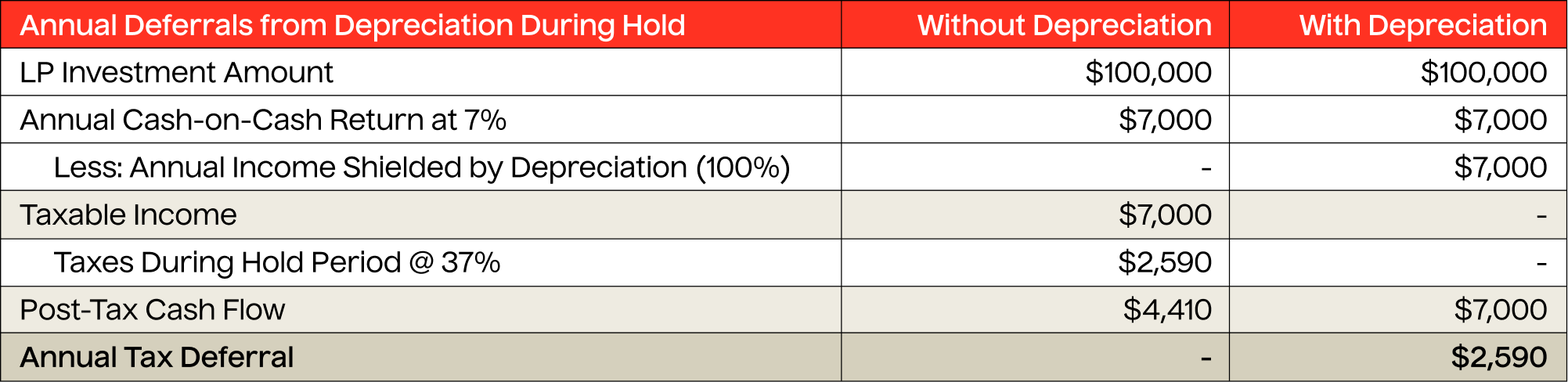
For example, assume a GP acquires an industrial property for $5 million, with $1 million allocated to land and $4 million to the building. An LP investing $100,000 earns a 7% annual cash-on-cash return, or $7,000 per year. Assuming depreciation fully shields the property’s income during the hold, the investor can defer $2,590 in taxes annually, to be taxed upon sale at a 25% rate as opposed to the ordinary tax rate of 37% in the same year.
Cost Segregation and Bonus Depreciation in Real Estate
Typically, depreciation is spread evenly over the life of the building’s useful life. However, sponsors are able to speed up those deductions through cost segregation. This involves hiring an engineering firm to identify individual parts of a property, such as flooring, landscaping, or parking areas, which can be depreciated over shorter periods. Front-loading these deductions allows more of the tax benefits to apply in earlier years, which improves cash flow without changing the property’s actual performance. This also has the ability to generate passive losses, which investors can use to offset other passive income within their portfolio.
The Tax Cuts and Jobs Act expanded this strategy with bonus depreciation, which lets sponsors write off qualifying assets immediately in the year they’re placed in service. While bonus depreciation began phasing down in 2023, the One Big Beautiful Bill Act restored 100% bonus depreciation for eligible property acquired and placed in service after January 19, 2025. This generally applies to qualifying assets with recovery periods of 20 years or less, including certain components identified through cost segregation studies, rather than the entire value of a commercial building.
Accelerating deductions in this way can significantly improve tax efficiency by capturing more of the available benefits upfront to offset income in the early years of the investment. While this reduces the remaining depreciable basis, and therefore limits future depreciation, it doesn’t eliminate the advantage altogether. Excess losses can generally be carried forward, allowing investors to apply them against future years’ income.
How 1031 Exchanges Can Defer Capital Gains Taxes
A 1031 exchange allows investors to defer certain taxes on the sale of qualifying investment or business real estate by reinvesting into like-kind replacement property. Under Section 1031 of the Internal Revenue Code, an investor generally must identify potential replacement property within 45 days of the sale and complete the exchange within 180 days, or an earlier applicable tax-return deadline.
Unlike depreciation, which can reduce taxable income during ownership, a 1031 exchange generally addresses the recognition of gain when a qualifying property is sold. Investors can potentially defer capital gains and certain depreciation-related tax liabilities while keeping more capital invested in real estate.
Not every real estate investment qualifies for a 1031 exchange. Direct ownership of qualifying real property may be eligible, while partnership interests and many private real estate fund interests generally are not. Investors should work with qualified tax and legal advisors to determine eligibility and properly structure an exchange.
For a detailed explanation of the requirements and available investment structures, read our 1031 Exchange Guide.
Depreciation and the Tax Implications of a Sale
When an investment property is sold, depreciation doesn’t disappear - it simply affects how the gain is taxed. Over time, depreciation reduces the property’s adjusted basis, which increases the gain recognized at sale. The portion of income that was sheltered by depreciation during the hold is recaptured at sale and taxed at a maximum federal rate of 25%, instead of the higher 37% ordinary income rate that would have applied if it were taxed annually. The remaining profit — the true gain on sale — is taxed at the long-term capital gains rate of 23.8% (including the net investment income rate).
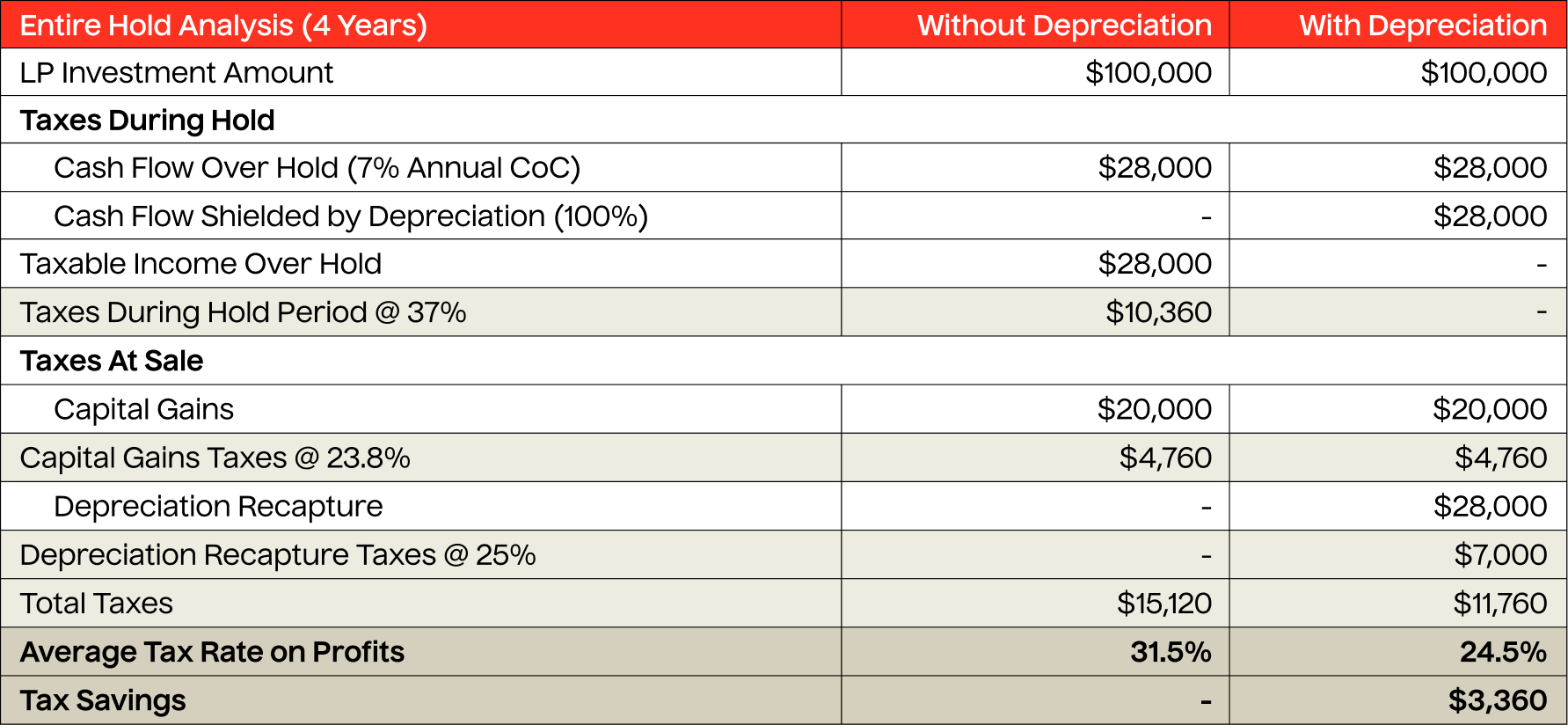
This creates a clear tax deferral advantage. For example, an LP investing $100,000 in a property earning a 7% annual return over a four-year hold would pay $15,120 in total taxes without depreciation. With depreciation and later recapture, that total drops to $11,760, which yields $3,360 in savings. These figures are simplified illustrations and do not account for every potential tax consideration, including passive activity loss limitations, differences in depreciation recapture treatment, or individual and state tax circumstances. Actual after-tax results will vary. The deferred taxes are still paid upon sale, but at lower recapture rates instead of higher ordinary income rates, which allows investors to keep more of their earnings working throughout the investment.
The Benefits of Tax-Equivalent Yield
Tax-equivalent yield is a prime illustration of how private real estate’s tax efficiency can significantly enhance after-tax returns. Because a notable portion of real estate distributions are often sheltered by depreciation and other deductions, investors are able to retain more of their income than they would from other investment vehicles.
For instance, a 7% cash-on-cash return which is fully sheltered by depreciation would deliver the same after-tax income as a taxable investment yielding roughly 11%, assuming a 37% marginal tax rate. This allows investors to achieve comparable after-tax results while taking on less risk. Evaluating returns through a tax-equivalent lens helps demonstrate the true power of tax-efficient income, highlighting not just what’s earned, but what’s ultimately kept.

How Tax-Efficient Real Estate Investing Can Improve After-Tax Returns
Tax efficiency is an important consideration when evaluating private real estate investments. Depreciation, cost segregation, bonus depreciation, and qualifying 1031 exchanges can potentially reduce current tax liabilities or defer the recognition of taxable gains, allowing more capital to remain invested.
However, these benefits depend on investment structure, tax eligibility, and individual circumstances. Investors should evaluate projected after-tax returns alongside property fundamentals, sponsor experience, financing, and investment risk.
For accredited investors, understanding the tax treatment of real estate investments can provide a more complete picture of potential long-term performance.


Annina Vaisanen
Annina Vaisanen is part of the Investor Relations team at Lightstone DIRECT, where she focuses on coordinating and enhancing the investor experience across the platform. In addition to overseeing investor relationships, she also plays a key role in streamlining systems and processes that support efficient operations across the group.
Do investors pay taxes on real estate distributions?

Real estate distributions are not necessarily taxed in the same way as the cash received. Depending on the investment structure and allocated tax items, depreciation and other deductions may offset some or all of the taxable income associated with distributions. However, distributions may have different tax consequences, and investors can owe taxes even when distributions are limited. Actual treatment depends on the investor's circumstances and the investment's tax reporting.
Can real estate investors defer capital gains taxes?
Yes. Investors may be able to defer certain capital gains taxes through a qualifying 1031 exchange, which allows the sale of investment or business real estate and reinvestment into like-kind replacement property. Strict identification and completion deadlines apply. Not all real estate investments or ownership structures qualify, so investors should consult qualified tax advisors before pursuing an exchange.
What is 100% bonus depreciation in real estate?
Bonus depreciation allows eligible property costs to be deducted more quickly than under standard depreciation schedules. Under current federal law, 100% bonus depreciation generally applies to qualifying property acquired and placed in service after January 19, 2025. In commercial real estate, eligible assets may include certain equipment, fixtures, and land improvements identified through cost segregation, rather than the entire building.
What is cost segregation in real estate?
Cost segregation is a tax planning strategy that identifies qualifying components of a real estate investment that can be depreciated over shorter periods than the building itself. These may include certain equipment, fixtures, and land improvements. By accelerating depreciation deductions, cost segregation can potentially reduce taxable income during the earlier years of an investment.
How does depreciation reduce taxes on real estate investments?
Depreciation allows investors to deduct the cost of qualifying income-producing real estate over its applicable recovery period. Residential rental buildings are generally depreciated over 27.5 years, while nonresidential buildings are generally depreciated over 39 years. These deductions may reduce taxable income without requiring an equivalent annual cash expenditure, although passive-loss limitations and depreciation-related taxes upon sale may apply.
What are the tax benefits of real estate investing?
Real estate investing may provide tax benefits through depreciation deductions, cost segregation, bonus depreciation, and the deferral of certain capital gains through qualifying 1031 exchanges. These strategies can help reduce current taxable income or postpone certain tax liabilities. The benefits available to an investor depend on the investment structure, applicable tax rules, and individual circumstances.