The Promote, Decoded: How Sponsors Get Paid in Private Real Estate

In the back half of any private real estate offering document — past the property description, past the market analysis, somewhere near the partnership-economics section — there is a paragraph that describes how the general partner gets paid. It usually opens with a phrase like the General Partner shall receive 20% of distributions above an 8% preferred return. And in five clean words it tells the reader the most important thing about whose side the GP is on.
That single sentence is the promote — the portion of profits a sponsor earns above the LP's preferred return. It is the GP's share of LP outperformance. It is the structural device that converts "trust me, this deal will do well" into "I am paid more when you are paid more." When it is well-calibrated, the promote is perhaps the single largest reason GPs and LPs end up rowing in the same direction. When it is poorly designed, it can be a major source of misaligned incentives in a JV partnership private real estate deal.
The promote is the most important paragraph in the LP's offering document, and the one that may not receive due attention from less experienced accredited investors. It is also misunderstood in three predictable ways:
That last point is worth drilling into further. A promote (or specifically a more generous promote to LPs) should not be considered in a vacuum. If the sponsor/GP has no “skin in the game,” they may still lack proper incentive to perform on behalf of LPs. In other words, a lower promote may not necessarily be optimal.
Let’s dive deeper.
What a Promote Is, and Isn't
A promote is the GP's share of cash flow above a defined threshold across the lifetime of the investment. This threshold is almost always the LP’s preferred return. The promote is paid out of distributable profits, not out of LP capital. When the deal performs at or below the pref, the GP receives no promote; when it outperforms, the GP receives a portion of the excess.
The promote is not a management fee. Fees are paid regardless of deal performance — typically a small percentage of equity raised or assets under management, billed annually to cover the sponsor's operating cost. The promote is performance compensation; the fees are operating compensation. A well-aligned GP earns relatively little from fees and meaningfully more from the actual performance of the investment they are managing. WIth respect to the promote, this means the GP earns a healthy total return when the LP earns a healthy total return. As noted above, co-investment also matters here: the more “skin in the game” the GP has, the more risk and profit potential they hold in the deal. A poorly aligned GP earns the reverse — substantial fees regardless of outcome and a small promote that barely matters either way.
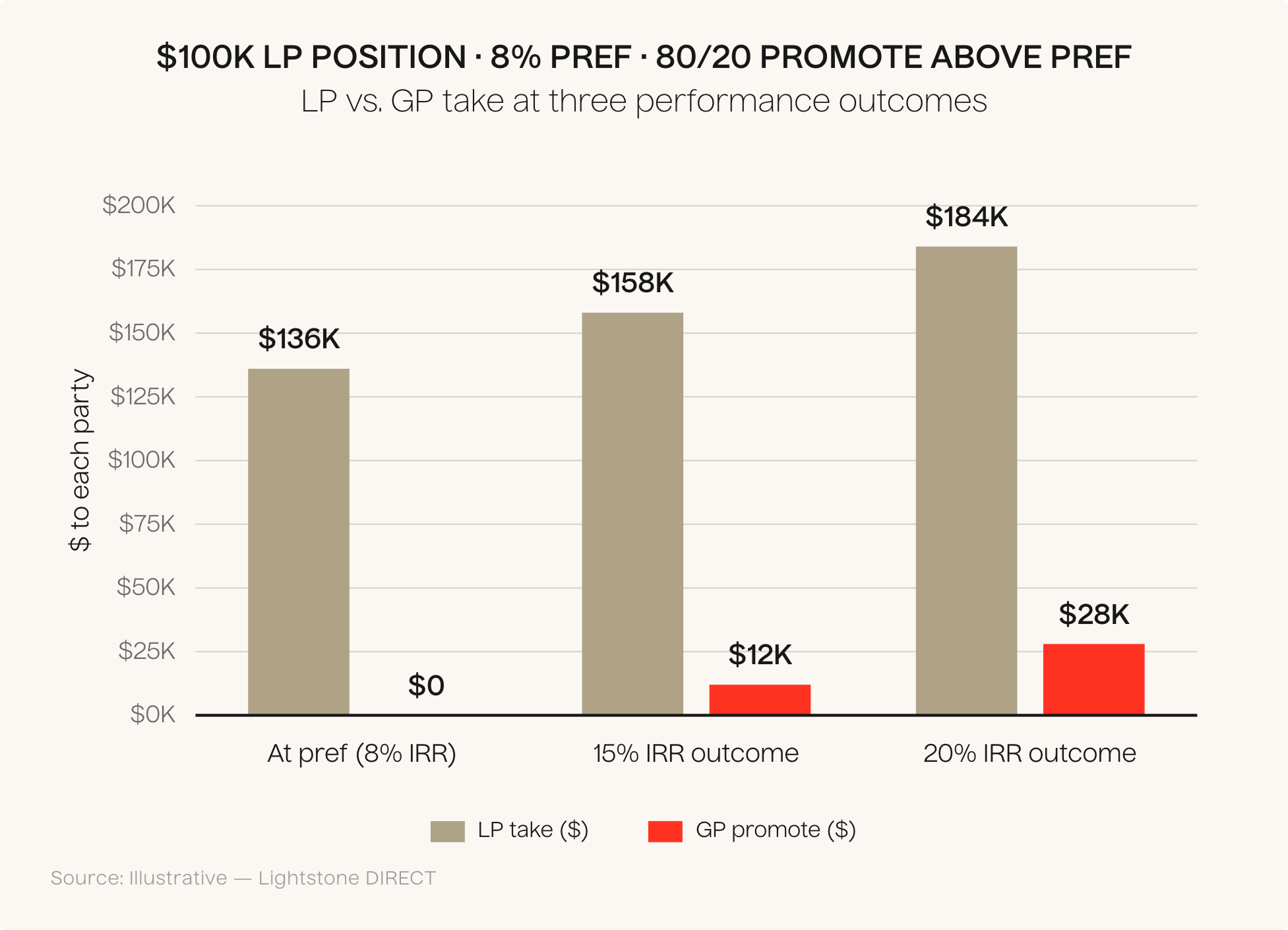
The promote is also not a guarantee that the GP outearns the LP at any particular performance level. The promote tier kicks in only above the pref, and even then it is a share of the excess, not a multiple of it. In a typical 80/20 split, the LP still receives 80% of every dollar above the pref. The GP earns more dollars per percentage point of equity than the LP — that is the carry on a smaller equity position — but the LP's absolute dollars almost always remain larger.
How the Promote Sits in the Waterfall
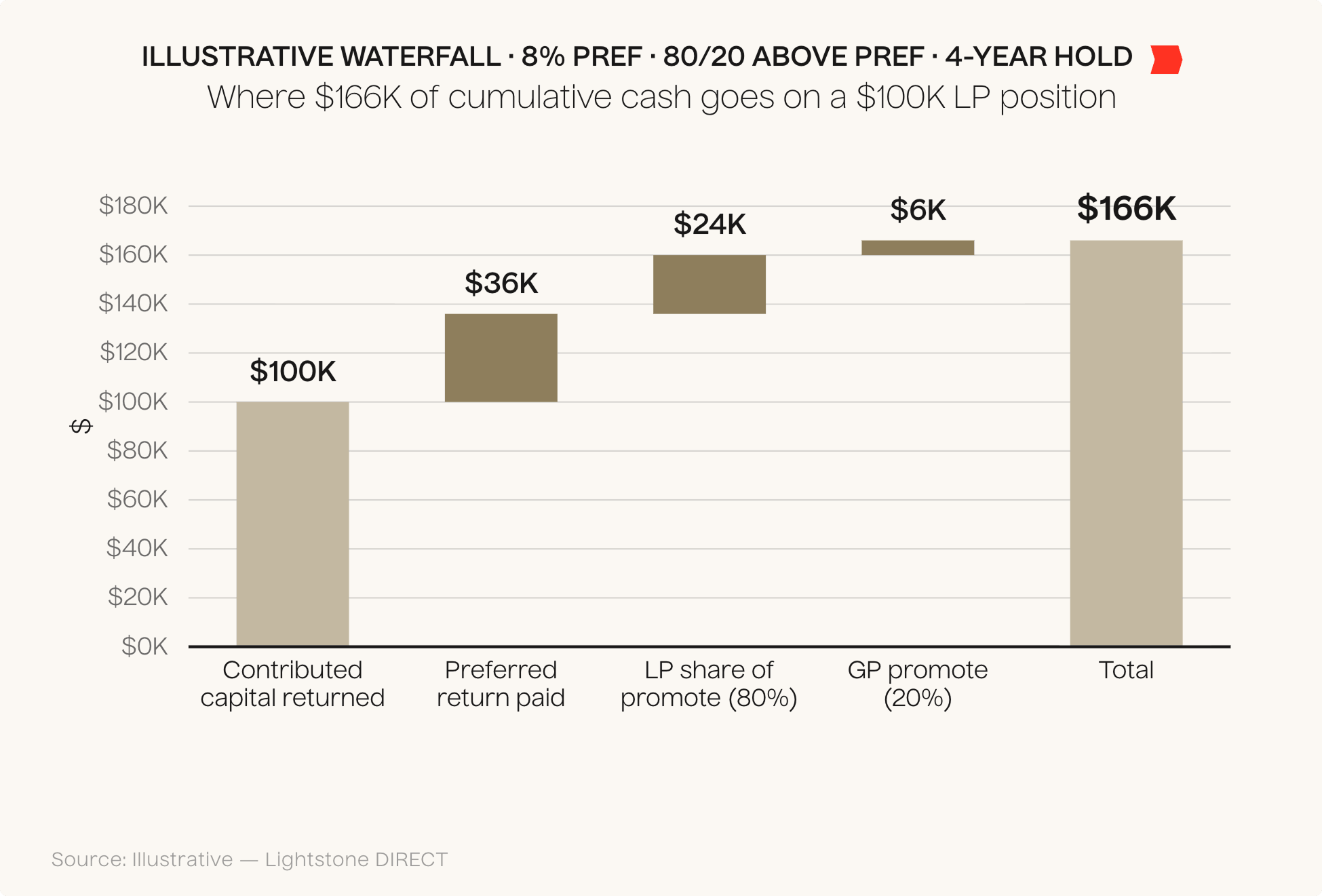
A real estate distribution waterfall is the priority order in which cash flow moves from the deal to the partners. The promote tier sits near the top of the stack, not the bottom. A typical institutional structure pays out in this sequence:
The illustrative companion visual below walks through a $100,000 LP position in a four-year value-add multifamily deal — the same example used in the preferred return piece — and shows where each dollar lands as the waterfall executes. In a strong outcome, the LP receives capital back, pref, and the 80% LP share of the promote tier; the GP earns its 20% on the excess. In a weaker outcome, the LP still receives capital and pref before the GP earns anything above its co-invested share.
Single-Hurdle vs. Multi-Hurdle Structures
Most deals use one of two structural shapes for the promote tier itself.
A single-hurdle promote is the simpler structure: a single ratio (e.g., 80/20) applies to all distributions above the pref, no matter how strongly the deal performs. The GP earns 20% of every dollar of LP outperformance, from the first dollar above the pref to the last. Clean, predictable, easy to model. The downside: the GP does not earn more for crushing the deal than for modestly outperforming it. Beyond the pref, the marginal incentive is constant.
This is typically the case with a Lightstone DIRECT offering.
A multi-hurdle promote stratifies the promote tier by IRR threshold. A typical structure might pay 70/30 above the pref, then 60/40 above a 15% IRR, then 50/50 above a 20% IRR. The GP earns a progressively larger share of profits as the deal outperforms more meaningfully. The intent is to incentivize the GP to push for outsized outcomes rather than coast above the pref. The trade-off, from the LP's perspective: in best-case scenarios where the deal exits at high IRRs, the LP gives back a meaningful share of upside to the GP that a single-hurdle structure would have preserved.
This may be the case with a ground-up investment, where the GP can justify aggressive promote tiers to compensate for liability and execution risk.
Which is better for the LP depends on the asset class and the operator. For heavier value-add or development business plans where the upside scenario depends on operational lift the GP delivers, a moderately progressive multi-hurdle structure aligns the operator's effort with the LP's outcome. For stabilized core-plus assets, or lighter value-add, where the upside is more about market beta than operator skill, a single-hurdle promote tends to be more LP-friendly.
The GP Catch-Up — Where Aggression Hides
The catch-up provision deserves its own paragraph because it is the place where the structural difference between a moderate GP-friendly waterfall and an aggressive one is largest, and where it gets the least scrutiny in a first reading of the offering document.
A moderate catch-up — typically 50/50 — gives the GP half the cash flow above the pref until the GP's cumulative share equals its overall promote percentage on profits to date, at which point the standard promote split resumes. The GP catches up to its promote share gradually, sharing each marginal dollar with the LP until parity.
An aggressive catch-up — sometimes 100/0 — gives the GP all of the cash flow above the pref until the GP has caught up. The LP receives nothing during the catch-up tier. In deals with both a low pref and an aggressive catch-up, the LP can be effectively diluted on early outperformance: the pref ends, and the next several dollars go entirely to the GP.
Two questions matter when reading the catch-up language: (a) what percentage of cash flow goes to the GP during the catch-up, and (b) is there a cap on the catch-up duration (i.e., does it stop once the GP has reached its promote share on aggregate profits, or does it continue indefinitely)? The institutional answer is 50/50 with a hard cap; the LP-unfriendly answer is 100/0 with looser cap mechanics.
Why the Co-Investment Multiplier Matters
The headline promote ratio is the rate; the GP's co-investment is a form of leverage applied to that rate. A 20% promote earned by a GP with 2% of the equity behaves very differently than the same 20% promote earned by a GP with 20% of the equity.
In the first case, the GP earns its promote almost entirely from LP outperformance and risks very little of its own capital. The promote is the GP's economic upside; downside lives on the LP's side of the table. In the second case, the GP has meaningful capital at risk below the pref tier — its own contributed capital is in the priority stack alongside the LPs', subject to the same outcomes. The promote is paid on top of capital already at work.
Lightstone, a national operator with a 40 year track record, generally commits at least 20% of the equity into Lightstone DIRECT transactions — well above the 2–5% industry norm. The promote is structured to earn appropriately on outperformance; the 20%+ co-invest is the test of whether the firm believes in the deal regardless of the promote tier ever activating. A deal that performs at or below the pref pays the GP nothing on its promote — but Lightstone's own capital is in the deal either way. That structure is what alignment looks like in practice. It is also what makes a moderate promote rate sit on top of meaningful skin in the game, rather than substitute for it.
What LPs Should Read For
Five structural questions matter more than the headline ratio when reading the promote language in a PPM.
What is the catch-up percentage and does it have a cap? 50/50 with a hard cap is institutional; 100/0 with unclear cap mechanics is a flag.
Is the promote tiered by hurdle, and how aggressively? A modest multi-hurdle structure (70/30 → 60/40 → 50/50) rewards outperformance without giving the LP too much back. An aggressive one (70/30 → 50/50 → 30/70) inverts the share of upside at the levels where the deal performs best.
How much capital does the GP have in the deal? 20%+ co-invest is meaningful alignment. 2–5% is the industry norm1. Anything below 2% should be a hard question for the sponsor.
Where does the catch-up sit relative to return of capital? The institutional standard is to return all LP capital before the catch-up tier even begins. Some deals invert this; that's a flag.
Are the promote and management fees structured to discourage early sale? A GP that earns a large promote on a quick flip but moderate ongoing fees on a long hold is incentivized to sell at year three even if year five would deliver more value. The well-structured deal aligns hold-period economics with LP outcomes.
The Promote Tier Is the Test
The promote paragraph is short. The math underneath is not. Cumulative-and-compounding pref, return of capital before catch-up, moderate-to-progressive promote splits, hard caps on aggressive provisions, and a GP that has put real capital alongside the LP — these are the structural features that determine whether a 20% promote behaves like a 20% promote or like something materially worse.
Read the promote tier the way you would read the bid-ask on any other deal: the headline number is the door, the structure is the room, and the GP's own capital sitting in the same priority stack is the test of whether the people sitting across the table are on the same side of the deal you are.
Further reading: Internal Revenue Code Section 704(b) (partnership allocations of profit and loss); U.S. Securities and Exchange Commission Investor Bulletin on Private Placements Under Regulation D; Internal Revenue Code Section 469 (passive activity loss rules).

Soren Godbersen
Soren Godbersen is Chief Growth Officer at Lightstone DIRECT, where he oversees investor experience, day-to-day operations, marketing, and strategic direction of the group. Previously Godbersen was Chief Growth Officer at EquityMultiple, a category-defining real estate investment platform for accredited investors where he led the Marketing and Investor Relations Teams, helping to grow the firm’s AUM to nearly $1B, and investor network to over 5,000 individual high-net-worth investors. Godbersen holds a Bachelor's of Arts in Economics with Honors from Whitman College.