The Lightstone Letter — October 2026

Where the Growth Went
One story running through public and private markets, and how to find income that doesn't depend on it.
One macro theme now runs through most of the places an investor might look for growth: the S&P 500's revenue gains, the largest private valuations, a large share of private-credit lending, and a growing slice of private real estate and infrastructure. We hardly need to name it at this point, but it shares initials with a fearless hall-of-fame point guard.
We used to talk about the divide between public and private markets, and credit or equity. Beta or alpha; stability or upside. These days, however, these labels do not cleanly sort risk/return profiles for us. These classifications no longer provide a clean blueprint for diversification.
Companies used to go public to grow. Increasingly, they go public after much of their valuation has already been built. Amazon listed in 1997 at a market value of about $438 million (or roughly $920M in today’s dollars); SpaceX listed this June at $1.77 trillion, and Anthropic is preparing to follow at up to $2 trillion — values built almost entirely in private hands, before anyone could buy a public share.
What public investors get instead is an index whose growth increasingly runs through one industry: by Morgan Stanley's estimates, hyperscalers and AI cloud providers will account for about 5% of S&P 500 revenue next year but roughly a quarter of its revenue growth. That chain has shown strain this fall, from a sharp revision to OpenAI's reported revenue to a force majeure notice on a $165 billion data center project.
Individual investors have noticed. Over the past several years they have moved steadily into private markets, and this year they have started choosing more carefully which parts. Private credit funds generated some stinky headlines, limiting withdrawals to 5% per quarter while requests ran at more than double that, and private credit fundraising is down sharply; real estate and infrastructure fundraising is up. If you are on a quest for returns that don't depend on a handful of AI-linked companies, you aren’t alone.
If one wants to diversify away from the AI tsunami, where does one turn? Private credit? Non-traded REITs? Pre-IPO companies?
The challenge is that each of these options may largely rest on the same bet.
Getting in Before the Bell
If the growth now happens before the listing, the obvious move is to get in earlier, and plenty of investors are trying. This is a real gap that individual investors are chasing. In the 1990s, the median American IPO came to market worth $163 to $372 million in today's dollars, and in 2025 the median was about $1.56 billion.
The way in for individuals is narrow, and it can be expensive. Fundrise's Innovation Fund, more than a fifth of it Anthropic, traded as high as $575 after its March debut and around $30 by late September.
More to the point: several of the largest private valuations belong to the companies at the center of the AI story: Anthropic, now preparing to list, and OpenAI, whose revenue came in well below earlier reports in October. Owning a slice of an AI company before it lists can be a perfectly reasonable bet. A pre-IPO stake like that adds to the AI exposure an investor already holds through the index, usually at a higher entry price, and its value rides on one company's next round or listing.
The Concentration Is Not Just Public Markets
We are not calling a correction, and we are definitely not calling the magnitude or timing of a correction. Hopefully the AI bet pays off broadly, and this will all seem like worthless hand-wringing in a year. But if overconcentration does prove disastrous, we may find ourselves looking back at the following as warning signs along the road:
- Hyperscaler and AI-cloud revenue is about 5% of S&P 500 revenue, but drives roughly 25% of the index's revenue growth.
- Oracle issued a force majeure notice on "Project Jupiter," a $165B New Mexico data center, to the developer — a Blue Owl unit — after gas-pipeline permitting delays; Oracle and Blue Owl shares each fell about 4%
- Hyperscalers have sold about $255B of unsecured bonds this year and disclosed more than $1.1T of data center lease commitments not yet started — what Morgan Stanley calls "synthetic capex."
Maybe not great when one of the world’s largest banks is inventing new terminology that makes stock market growth sound more like motor oil. "Synthetic capex" may have real consequences, however, because it could pull private real estate into the AI bet as well. Instead of building and owning every data center, hyperscalers increasingly sign a lease and let someone else own the building. How much AI risk the owner shoulders depends on who signs the lease, and on who that tenant depends on.
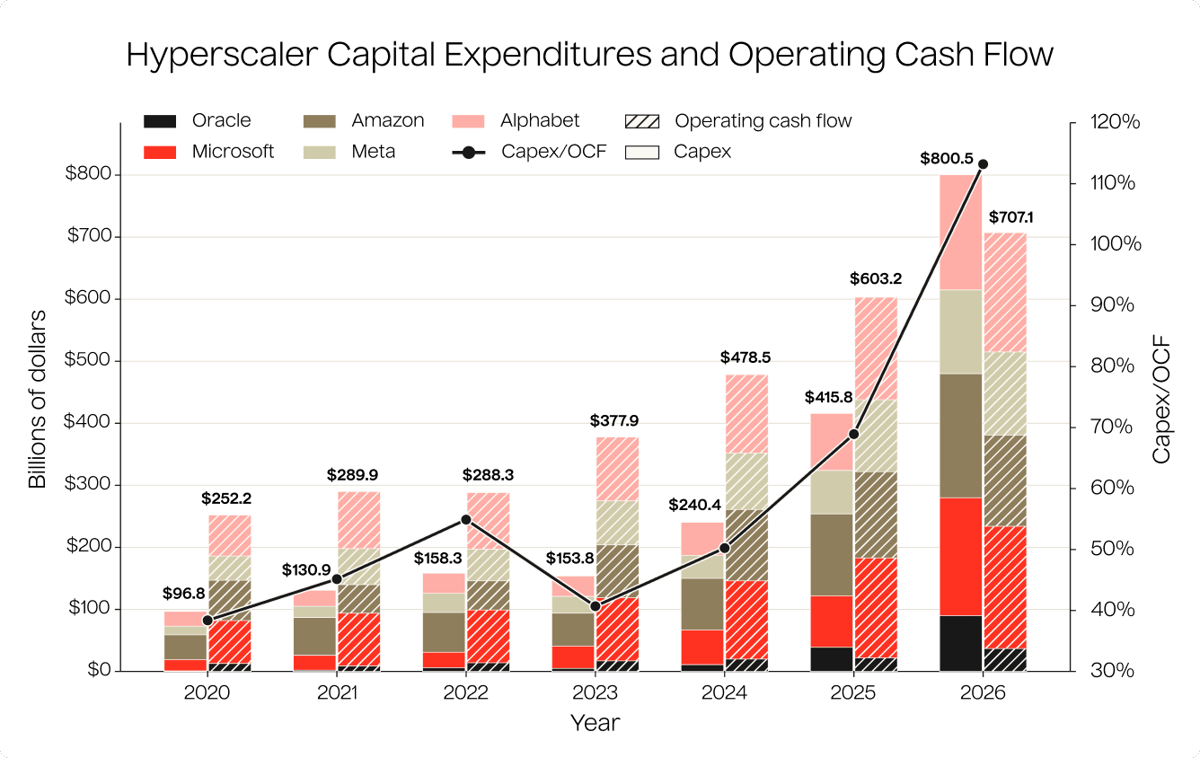
One of these things is not like the others…
Project Jupiter, the New Mexico campus behind that force majeure notice, shows the long version of the chain. Oracle is set to lease the campus, with OpenAI as its primary customer. Oracle ended its latest fiscal year carrying about $130 billion of debt, and more than half of its contracted backlog reportedly comes from OpenAI. OpenAI, in turn, depends on AI revenue that came in about $20 billion below earlier reports this fall. The rent depends on Oracle, Oracle depends heavily on OpenAI, and OpenAI depends on the AI bet paying off. If you buy a piece of a building like that to get away from AI, you end up owning the AI bet with a roof on it, and no great Plan B if your only tenant pulls out – unlike various other commercial real estate assets, there is no established downside scenario if the only tenant pulls out.
Circular AI demand is not lurking behind every one of these deals. At Meta's Hyperion campus in Louisiana, where Blue Owl funds are the majority owner, Meta has guaranteed the property's value for 16 years, which may be just fine considering how robust Meta’s revenue is, owing mostly to a thriving ad business. Owning a piece of that building looks more like owning a Meta bond. Both campuses would show up in a fund report as "data centers," or more broadly as "real estate" or "infrastructure." Which asset class you actually own, and how much distance that buys you from AI, depends on who is paying rent and the underlying structure.
These trends make clear that moving into private-market hard assets doesn’t necessarily buy you distance from AI. Blue Owl’s fortunes may be largely hitched to the AI buildout. Meanwhile, the largest non-traded REIT enjoyed strong performance in 2025 via 20% allocation to data centers.
Private credit holds the same story from both ends. Morgan Stanley expects private credit to be the largest single source of debt behind the buildout, roughly $800 billion through 2028. Meanwhile, about a fifth of what BDCs lend goes to software companies (business development companies – a wrapper entity, functioning similarly to a REIT, through which individual investors own private credit). The Bank for International Settlements finds most of that sits in the kinds of software AI can most directly replace. Private credit finances the buildout and lends to the businesses the buildout threatens.
None of this makes those loans or leases bad. Data center tenants are mostly investment-grade companies, and very few software loans are behind on payments. The concern is correlation: if the AI bet fails, so too do these funds, even if they wear the “private markets” label.
Shifts in Private-Market Focus
Even with the stock market showing sustained resilience, individual investors haven't soured on private markets. But within private markets, the capital flows diverge among asset classes. Individuals are moving from private credit toward hard assets.
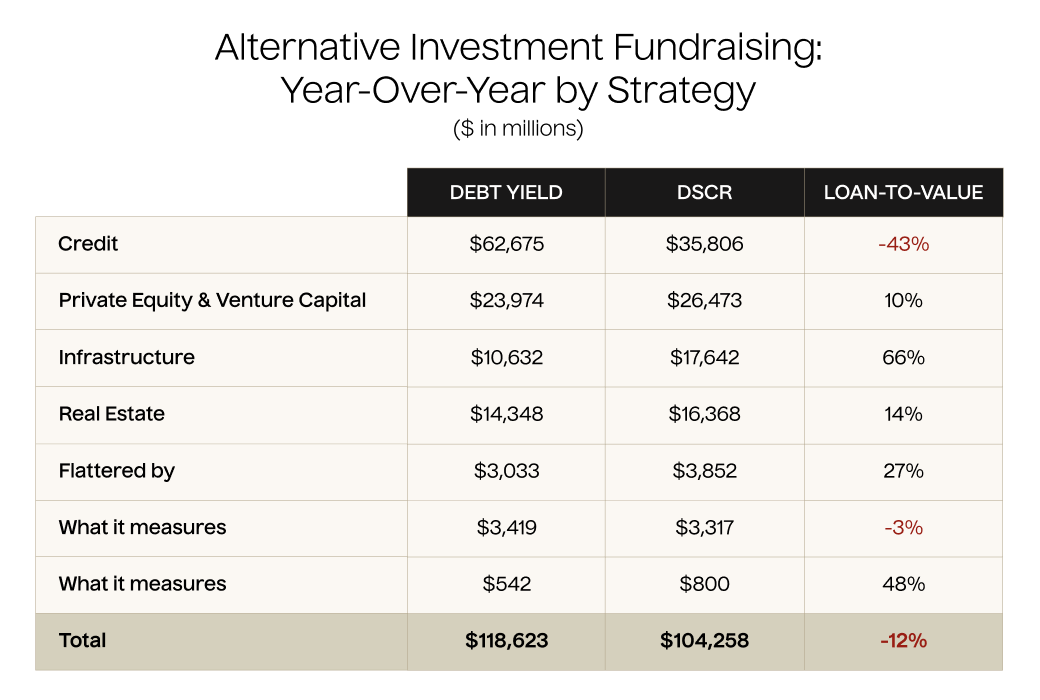
While total fundraising to alts has fallen year-over-year, to this point, this is really two trends in one. The vast majority of the dip has been from private credit. Private real estate allocation has increased 14% YoY, while infrastructure rose 66%.
While plenty of other hard assets comprise ‘Infrastructure,’ data centers have become a major infrastructure asset class in their own right, so some of the money leaving private credit may be landing back in the AI buildout, one door over.
So as we deconstruct “hard assets” further, where can diversified, less correlated investment income be found?
Count the Rent Checks
The antidote for these modern times may be something boring, and a little more slow-moving. Something that has existed in tangible form for years, rather than largely in the cloud, in the future. Preexisting real estate, of a particular vintage, that delivers return through stable cash flow. Nothing circular, nothing speculative — as transformative as we all believe AI will be, the tangible net gains for the economy remain fuzzy.
The place to look may be an asset whose income comes from its own operations — rent collected, leases renewed, value-add improvements — bought for less than it would cost to build. Diversified tenant mix matters as well.
Picture a Saturday at OKC Outlets: a family that drove two hours for back-to-school shoes, a nurse coming off a night shift, an airman from Tinker Air Force Base killing an afternoon, a teenager spending birthday money at Adidas. Their paychecks come from hospitals, the base, energy companies, schools and small businesses spread across a trade area that reaches well beyond the city. That spending flows to 94 different tenants. Nike, the largest, takes up less than 5% of the center’s space, and the rest is spread across apparel, footwear, accessories, home goods, beauty, kids’ clothing and food. The stores also pay a modest share of what they take in in rent: permanent tenants pay roughly $10 for every $100 in sales. Some of those retailers will have a bad year, and so will some of their customers’ employers. It is very unlikely they all have the same bad year for the same reason. Class B multifamily, shallow-bay industrial, and other CRE asset classes may offer similar stories of diversified rent rolls.
A data center leased to a single hyperscaler can be an excellent credit, and its income still rests on one tenant, and sometimes on that tenant's own biggest customer.
For any investment, AI-linked or not, a few questions get at the difference:
- Who’s paying rent, and how many separate payers are there?
- Do those tenants depend on the same handful of companies, or the same industry?
- What did the sponsor pay, relative to what it would cost to build today?
- Does the plan rely on operations (leasing, renewals, improvements), or on the market paying a higher multiple later?
- How much of the sponsor's own capital sits in the same deal?
Private real estate, like outlet retail or shallow-bay industrial, carries its own risks: e.g., interest rates, the health of the local economy, no quick exit. A broad recession would touch all asset classes, including these sectors. What these private real estate sectors offer may be particularly useful right now, however: cashflow and an investment thesis that does not depend on meteoric growth in a nascent industry. We’re all invested in AI, whether we like it or not, and we can all hope the AI bet pays off handsomely. If some of your portfolio can do well with the AI story getting tired, or hitting pause entirely, that’s a good thing.

Soren Godbersen
Soren Godbersen is Chief Growth Officer at Lightstone DIRECT, where he oversees investor experience, day-to-day operations, marketing, and strategic direction of the group. Previously Godbersen was Chief Growth Officer at EquityMultiple, a category-defining real estate investment platform for accredited investors where he led the Marketing and Investor Relations Teams, helping to grow the firm’s AUM to nearly $1B, and investor network to over 5,000 individual high-net-worth investors. Godbersen holds a Bachelor's of Arts in Economics with Honors from Whitman College.


