Debt Yield, Decoded: The Lender's Metric Every LP Should Read

Picture a credit officer at a commercial real estate lender. She isn’t modeling rent growth or debating the exit cap rate. She is dividing one number by another and studying the quotient. The question she is asking is narrow and unsentimental: if the borrower hands back the keys in year two and the building becomes the lender’s, what does it pay on the money the lender put out?
That quotient is the debt yield, and it is an often-overlooked figure on a term sheet. An accredited investor reading an offering memorandum will find a great deal of attention paid to projected returns and may find little on how the deal is levered. Debt yield is a quick gut-check on how conservatively the GP has used leverage. It takes one division to compute, it cannot be dressed up by a cheap interest rate or an optimistic sale assumption, and a limited partner learns more about a sponsor's risk posture from it than from any paragraph in the executive summary.
How to Calculate Debt Yield
The debt yield formula is a single line:
Debt Yield = Net Operating Income ÷ Loan Amount
A property generating $10 million of net operating income against a $100 million first mortgage carries a 10% debt yield. Shrink the loan to $80 million and the debt yield rises to 12.5%. Push the loan to $125 million and it falls to 8%. Nothing else enters the calculation. Not the interest rate, not the amortization schedule, not the term, not the purchase price, not the appraised value, not the cap rate the seller is hoping for.
That list of exclusions is the entire reason the metric exists.
Why Lenders Size Loans on Debt Yield
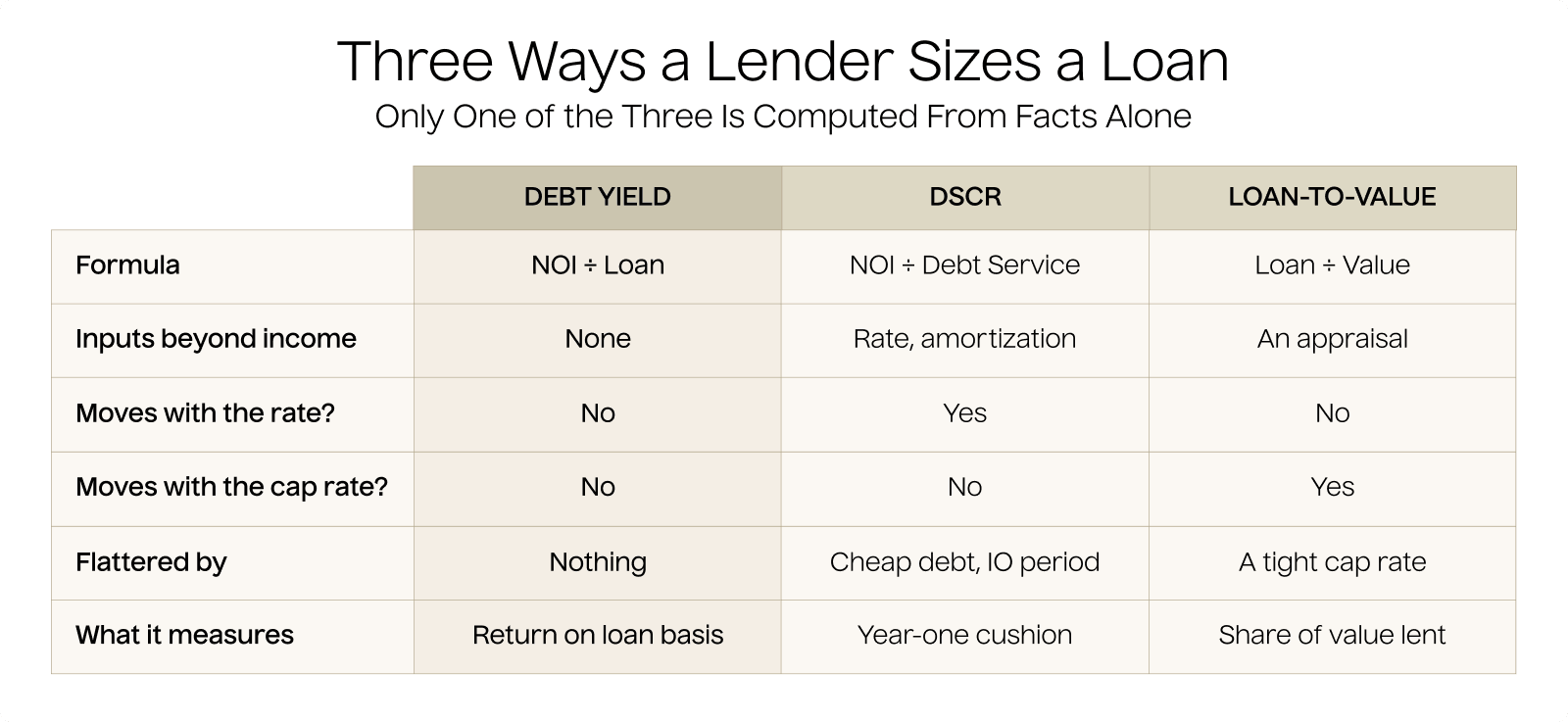
Each of the two older loan-sizing metrics relies on an additional input.
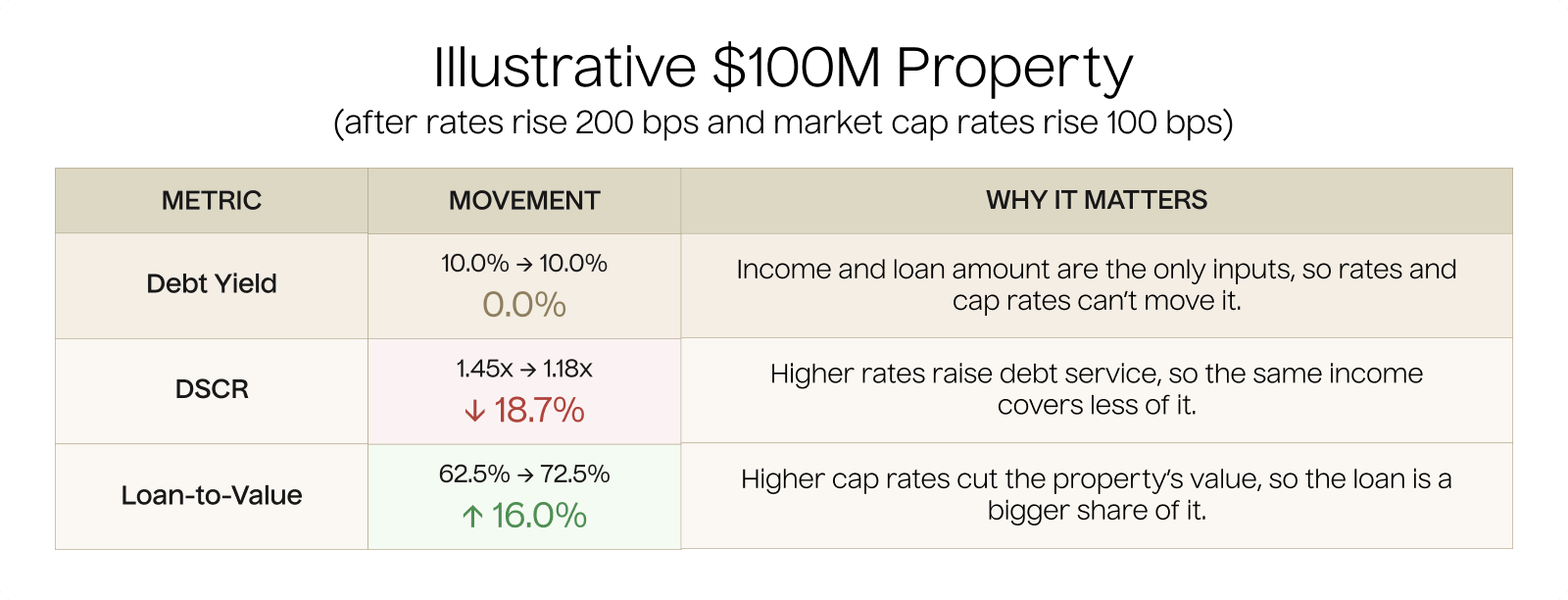
Debt service coverage ratio divides net operating income by annual debt service, which means it depends on the interest rate. Cut the rate by 200 basis points and DSCR improves without a single additional dollar of income arriving at the property. Add an interest-only period and it improves again. A 1.25x DSCR at 4% financing and a 1.25x DSCR at 7% financing describe two very different buildings carrying two very different loans.
Loan-to-value divides the loan by the property's value, which means it depends on an appraisal, which in turn depends on a cap rate, which is a market opinion that moves. A 65% LTV struck when the submarket traded at a 4.5% cap becomes something considerably less comfortable when the submarket trades at 6%. The loan did not change. Only the denominator did.
Debt yield has no second variable. Income over principal, both of them facts, neither a forecast. This is why it became the binding constraint in commercial mortgage-backed securities underwriting after 2008, when lenders discovered that loans sized comfortably on DSCR and LTV at the top of the cycle were sized catastrophically on any other basis. The compressed-rate years that followed, visible in any long look at the Federal Reserve's H.15 rate series, made the flaw plainer still: when money is cheap, DSCR and LTV both flatter the loan, and debt yield does not move at all.
A useful way to hold it: debt yield is the unlevered return the lender would earn if the lender owned the building outright at its loan basis. It is the cap rate on the lender's dollars.
What Is a Good Debt Yield?
There’s no official minimum for debt yield, and the numbers shift with interest rates and property type. Still, lenders tend to land in similar ranges. CMBS lenders have generally wanted at least 10% on stabilized commercial properties. Agency lenders financing stabilized apartments often accept 8% to 9%, since apartments are easier to sell and the rent comes from dozens or hundreds of tenants instead of a few. Hotels, single-tenant buildings, and transitional properties usually need more, because their income is less predictable or harder to replace if a tenant leaves.
The direction of travel matters more than the level. A debt yield below the convention for its property type means the loan is large relative to the income the building currently produces, and the business plan has to make up the difference. A debt yield well above convention means the sponsor borrowed less than the lender would have allowed, which costs some equity return in the good case and buys a great deal of room in the bad one.
How Accredited Investors Can Use Debt Yield When Vetting a Deal
For a limited partner, the number earns its place in four specific spots.
First, as a translation check. A deal advertising conservative leverage at 60% LTV has said something about an appraisal, and nothing directly about the property’s income. The debt yield can show substance (or lack thereof) for the LTV figure.
Second, on the in-place number rather than the stabilized one. Sponsors will quote debt yield on year-three pro forma net operating income, after the renovation program and the rent increases have all landed. That figure is a forecast masquerading as fact. The number that matters at closing is the debt yield on today's trailing income, because that is the cushion between the asset’s present circumstances and a very bad year for the deal.
Third, at the refinance. Most value-add business plans assume a refinancing or a sale within five to seven years, and the lender at that future date will size their loan on their own debt-yield minimum against the income the property produces then. An LP can run the same arithmetic in advance: take the pro forma stabilized net operating income, divide by the lender's likely threshold, and see what loan the property can support. If that number falls short of the existing debt, the business plan has a gap it must close with equity, a sale, or an extension.
Fourth, across sponsors. Debt yield is one of the few underwriting figures that compares cleanly between two unrelated deals, because it contains no local assumption. Two offerings in two different states with two different rate structures can be lined up side by side on this single metric.
Lightstone's underwriting treats debt yield as a co-equal constraint rather than an output, read alongside DSCR and loan-to-value, computed on in-place income, and stress-tested against the refinance threshold a future lender is likely to apply.
Limitations of the Debt Yield Metric
The metric is narrow by design, and the narrowness cuts both ways.
It says nothing about when the loan comes due. A 12% debt yield on a loan maturing in eighteen months is a worse position than a 9% debt yield on a ten-year fixed-rate note, and the formula cannot distinguish them. It says nothing about the quality of the income in the numerator: net operating income built on a single credit tenant with four years remaining and net operating income built on 240 apartment leases are not the same asset, and debt yield treats them identically. It is blind to reserves, to guarantees, to rate caps, to the capital expenditure the building will demand whether or not the income supports it. And net operating income itself is a figure with definitional latitude, sensitive to how management fees, replacement reserves, and non-recurring items are treated, which means a debt yield is only as clean as the income statement beneath it.
In other words, look at debt yield as a conversation starter, rather than the last word.
Debt Yield vs. IRR: What Each Number Tells You
“Yield” can mislead, because debt yield is not a return projection. The projected IRR assumes the sponsor’s business plan goes roughly as written: rents rise on schedule, the renovation finishes on budget, and the exit cap rate is as the model predicted. Debt yield is the property’s current net operating income divided by its loan. That makes it a measure of how much room the loan has if the plan slips. It is also the one leverage figure that a low interest rate or a generous appraisal can’t improve.
For an LP reviewing a deal, three steps cover most of its value:
- Ask for debt yield on trailing twelve-month NOI, not pro forma. On a $100 million loan, $10 million of in-place income is a 10% debt yield. If the sponsor quotes 12%, check whether that figure assumes $12 million of income the property doesn’t produce yet.
- Compare it to the norm for the property type. That’s roughly 8% to 9% for stabilized agency multifamily and around 10% for stabilized commercial property financed through CMBS. A lower figure means the business plan has to grow income to support the loan.
- Run the refinance math. Divide projected stabilized NOI by a likely lender minimum. At $9 million of NOI and a 10% minimum, the property supports a $90 million loan. If the existing loan is $100 million, ask the sponsor where the other $10 million comes from.
A debt yield below the norm doesn’t disqualify a deal on its own. Value-add plans often start there on purpose. It does mean the return depends on the plan working, which is worth knowing before you commit capital.
The projected return is what the deal earns if the plan works. The in-place debt yield measures how much margin the deal has if it doesn’t.
Further reading: Federal Reserve Statistical Release H.15 (for the interest-rate series underlying DSCR sensitivity); Mortgage Bankers Association commercial and multifamily research (for origination volumes and lending conditions by property type); Fannie Mae Multifamily and Freddie Mac Multifamily (for agency underwriting parameters on stabilized apartment assets); FDIC Risk Management Manual of Examination Policies (for the regulatory framing of commercial real estate concentration and loan-sizing discipline).

Soren Godbersen
Soren Godbersen is Chief Growth Officer at Lightstone DIRECT, where he oversees investor experience, day-to-day operations, marketing, and strategic direction of the group. Previously Godbersen was Chief Growth Officer at EquityMultiple, a category-defining real estate investment platform for accredited investors where he led the Marketing and Investor Relations Teams, helping to grow the firm’s AUM to nearly $1B, and investor network to over 5,000 individual high-net-worth investors. Godbersen holds a Bachelor's of Arts in Economics with Honors from Whitman College.


